
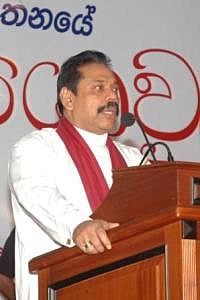
It is never easy being Sri Lanka's president. The island's chief executive has to deal with a seemingly intractable civil war, a faltering foreign-aid-dependant economy and a crumbling infrastructure. It is even more difficult being Mahinda Rajapakse these days. The rural politician, who became a human-rights activist and trade unionist on his way to becoming the most powerful person in the country, now spends time behind an extraordinary wall of security. Roads in Colombo are closed for hours when he ventures out of 'Temple Trees', his well-guarded official residence. Heavily armed commandos line the roads as his convoy speeds past, guards anxiously motioning away passers-by. While none of this is particularly unusual for a Sri Lankan president, just over a year after he took office President Rajapakse is looking particularly besieged for other reasons.
The most prominent recent furore has been over whether President Rajapakse cut a deal with the LTTE during the 2005 presidential elections to block Tamil votes for his opponent, Ranil Wickremasinghe. A recently sacked minister from his cabinet, Sripathi Sooriarachchi, said in March that he had been present at a meeting between the president's brother Basil and Tamil Tiger representatives when the alleged deal had been discussed. Sooriarachchi claims that he walked out of the meeting because he "did not agree with what was being said". (In February, Sooriarachchi was sacked along with former Foreign and Ports Development Minister Mangala Samaraweera, after they publicly opposed President Rajapakse over a cabinet reshuffle during which Samaraweera was demoted. Samaraweera claims he lost his job because he raised concerns over human-rights violations and the growing power of Rajapakse's brothers in government.)
As with previous elections, the central issue in the 2005 poll had been the on-going civil war. At that time, Rajapakse had campaigned on a hard-line platform with the backing of the Sinhala-nationalist parties, including the Janatha Vimukthi Peramuna (JVP) and the Jathika Hela Urumaya (JHU). Both of these parties oppose the 2002 Ceasefire Agreement, which Rajapakse's main rival, Ranil Wickremasinghe, signed with LTTE leader Velupillai Prabhakaran. As a result of this dynamic, President Rajapakse had attracted a significant number of votes from the Sinhala-dominated south. Wickremasinghe had then pledged to carry on with the peace process he had begun, and expected heavy Tamil support.
Rajapakse, who was then prime minister, won the presidential elections by a margin of less than 181,000 out of a total 9.7 million voters. In line with Sooriarachchi's allegations, election observers at the time noted that hundreds of thousands of Tamil voters did not come to polling stations because the LTTE called for – and violently enforced – an election boycott. The chief of a European Union election observer mission noted: "In the areas which the LTTE either controlled or exercised influence, there was little tangible evidence to show that an election process had actually taken place. Political campaigning was nonexistent, and voters were prevented from exercising their franchise because of an enforced boycott by the LTTE and its proxies."
As a result, the number of voters who turned out in the Tamil-dominated Jaffna District, for instance, was abysmal. Out of around 650,000 eligible voters on the peninsula, less that 10,000 voted – 71 percent of whom chose Wickremasinghe, to just 25 percent for Rajapakse. The former's supporters continue to contend that if Jaffna and other Tamil-dominated areas had been allowed to vote freely, Wickremasinghe would have won the presidency.