
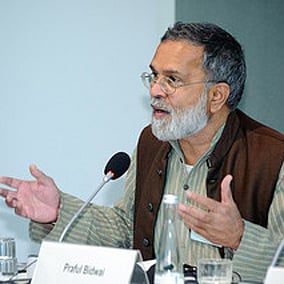
(Praful Bidwai (1949-2015), a senior journalist and political commentator, passed away earlier this week on 23 June. Bidwai wrote extensively on matters ranging from political economy and nationalism to environment and geopolitics. He was also a prominent anti-nuclear activist. In light of the Modi government's attempts at wielding greater control over the public broadcasting in India, here's Bidwai's piece from the December 1999 issue of Himal Southasian about how the Bharatiya Janata Party-led government was trying to ram through a Hindu sectarian agenda in media, culture and education. See his other writings for Himal Southasian.)
In mid-November 1999, the government sacked two directors of the Prasar Bharati (PB) Board, Romila Thapar and Rajendra Yadav, by invoking the principle of biennial 'rotation' of members. It did this because the government is not legally empowered to remove or appoint directors. Thapar is India's best-known historian, a world-class scholar, and a highly regarded public intellectual. Yadav is a reputed Hindi writer and commentator. Both are known for their independent views and their com-mitment to genuinely autonomous public media.
The government's midnight coup against Thapar and Yadav was a shocking violation of the spirit of media autonomy. The action deserves to be condemned not least because the PB came into existence after a quarter century of debate marked by the reluctance of successive governments to cede control over the powerful state-owned electronic media and vest it, in the model of the BBC, in a broad-based board which would not be answerable to the government. In a country where nearly half the population is illiterate, the electronic media enjoys a privileged status and has enormous reach.
The government could have applied an objective criterion to retire two of the six directors, such as in the drawing of lots, which had been proposed by the PB Board itself. Instead, this malicious targeting of Thapar and Yadav, termed "intellectual violence" by Jaipal Reddy, the man who helped establish the PB, showed up the BJP's motive. And that is to remove anyone who would oppose the BJP's attempt to control the powerful body. It is now widely expected that the two new directors to be appointed will be those whose worldview complements that of the BJP's own.