
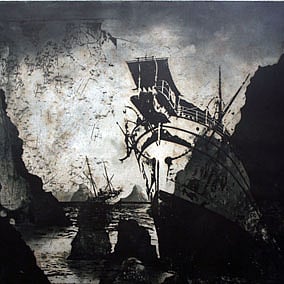
Since its founding in 1987, Karachi's V M Gallery has undergone a truly astounding transformation. The gallery was started under the aegis of the M A Rangoonwala Trust, with the aim of building an artistic space for Pakistan. Originally housing only a single downstairs gallery which a caretaker would unlock for the occasional viewer, it is now a thriving centre, with three galleries and a 600-seat auditorium, completely redesigned to accommodate large-scale local and international exhibitions.
The gallery has been actively promoting art in Pakistan, engaging with the media as well as the larger audience within and outside the country. The gallery's director Riffat Alvi has been at the forefront of the development of the modest art space into a multipurpose art centre. Alvi, being an artist herself, has been attending residencies and exhibiting abroad for a considerable number of years. This practice among Pakistani artists has been a contributing factor to the growing interest abroad in the country's art, bringing curators from around the world. In the other direction, artists such as Aamir Habib, also a political critic, have been invited to send their works to Europe. Recently, the gallery brought together over 150 local and foreign artists for the First International Print Biennial in September 2014.
Finding space
Printmaking is, unfortunately, one of the lesser appreciated art mediums in Pakistan. Naiza Khan, who was an advisor for the biennale explains why: "If we look at the development of contemporary printmaking in Pakistan, its growth spans a mere 64 years… It can be argued that printmaking as an independent art form did not have a chance to establish itself in this country as it has done in Europe, where its gradual development stretches right back to the mediaeval ages."
Another advisor to the event as well as a veteran artist and printmaker Meher Afroz adds, "We hardly had a proper art college in Pakistan until 1972. In Karachi, the Arts Council had a big hall, but no facilities for prints, and certainly there was no press, which is essential in printmaking. Some did linocuts, but for years there was hardly any proper workshop for prints, apart from the one at the Mayo School for Industrial Art in Lahore." With the return of three fresh graduates from the Slade School of Fine Art, London, the National College of Arts (NCA) in Lahore finally began its printmaking course in 1986.