
Regional energy integration has long been a pie in the Southasian sky. And like other grand visions that fail to materialise, the blame for this lack of success has fallen on geopolitics. But the traditional vision for energy integration was impractical, regardless of geopolitics or trade barriers. It was based on the premise that the very existence of energy resources in each of the Southasian countries provided adequate incentives for trading. The quantity of resources available in the Subcontinent, however, is not great enough to justify the costs of transportation within the region. In fact, it is in this very inadequacy of resources that the key can be found to regional energy integration. All the of Southasia's countries would benefit by combining their much-needed energy imports and distributing power through a common grid. Luckily, the new economic and political landscape of the Subcontinent today makes this a real possibility.
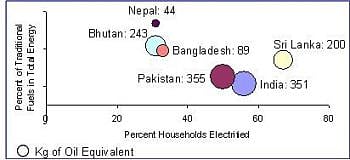
These are prosperous times for Southasia. Since 2000, regional economic growth has consistently averaged well over five percent, in spite of the political uncertainty and conflict in many parts of the region. India has set a blazing course at over nine percent for this fiscal year. Growth trends also reflect a deepening in the shift from agriculture to services and manufacturing. Increasingly, services and manufacturing sectors are driving economic growth. Sustained economic growth and the change in who is driving it have altered the political constituency of energy markets. Demand now pits increased energy security against increased energy access. Southasian countries have some of the lowest per-capita commercial energy consumptions in the world, reflecting both limited energy commercialisation and low levels of electrification (see Figure 1).
Policymakers have typically sought to increase energy consumption through increased electrification, and almost all of the region's countries currently have an explicit policy of improving access to electricity. Both India and Bhutan have ambitious goals of electricity for all by 2020. Bangladesh's poverty-reduction strategy seeks to extend transmission lines to all villages. Pakistan intends to reach another 40,000 households within the next year. And Sri Lanka intends to electrify 75 percent of households by 2010.
Policies on improving energy access were created at a time when economic growth was much more modest, oil prices were lower, and it seemed as if there was always going to be enough resources to simultaneously meet the dual objectives of growth and access. Now, the rising cost of energy, the vulnerability of supply links and the increasing scarcity of energy resources mean that somebody will have to do without. The trade-off between energy-for-growth and energy-for-access has now become visible.