
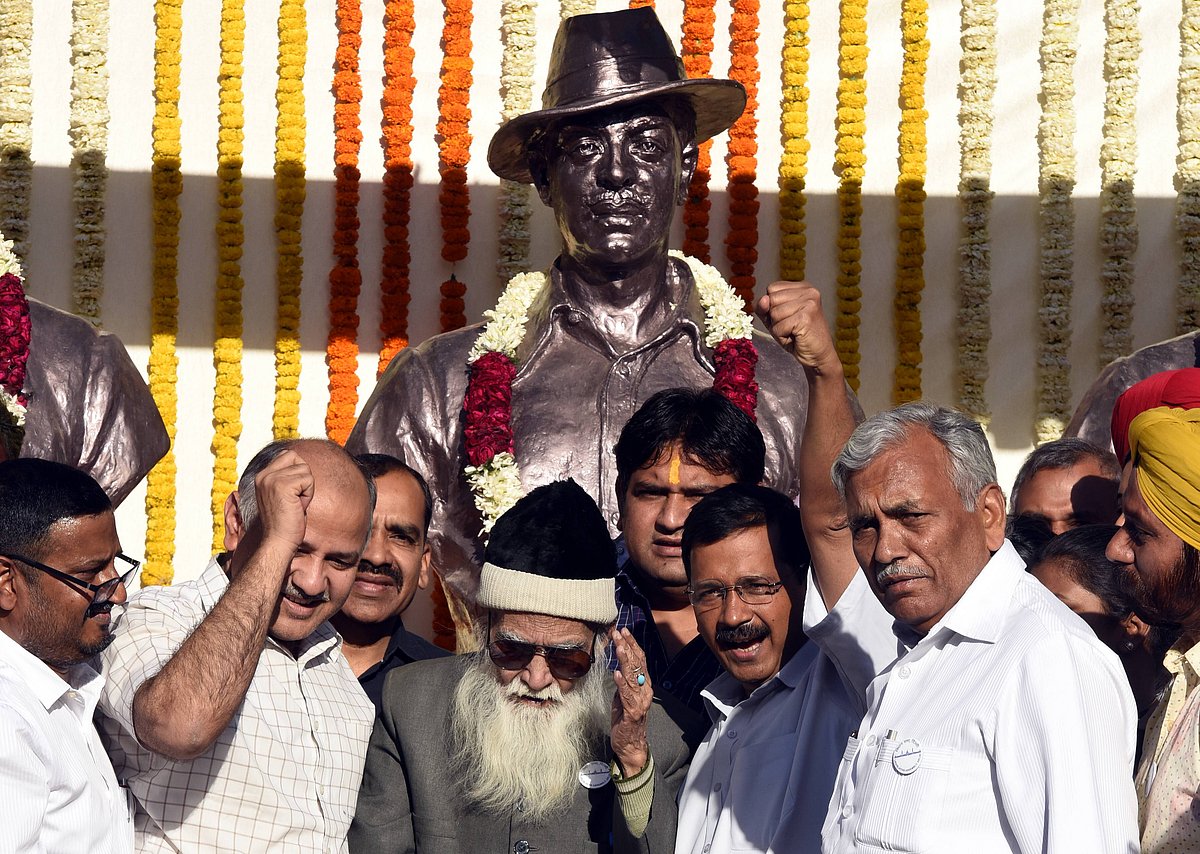
In July 2022, Simranjit Singh Mann, a member of the Indian Parliament from Punjab and a vocal backer of Khalistan – a separate Sikh state – made a controversial remark about Bhagat Singh, the iconic Indian revolutionary. Mann dubbed him a terrorist arguing that he had killed "innocent" police officers, one of whom was an Amritdhari, or baptised Sikh. In 1928, after the death of the Congress leader Lala Lajpat Rai, Bhagat Singh and his comrades assassinated British police officer John Saunders. While they were being chased by the police, it was Singh's associate Chandrashekhar Azad who shot the Sikh policeman. Mann also condemned Bhagat Singh's action of throwing bombs at the Delhi Legislative Assembly. Following his comments, Mann's supporters quoted and misquoted Bhagat Singh's writings to try and delegitimise him. They simultaneously launched an attack on Marxist and Communist thought by critiquing Bhagat Singh's ideas. In response, various leftist factions tried to defend Singh and launched an attack on Mann.
At present, Punjab is experiencing an economic crisis accompanied by political quandary. The agrarian sector is in a deplorable state, with an ever-increasing debt burden on farmers and agricultural labourers, resulting in alarmingly high rates of suicides over the last two decades. Simultaneously, Punjab, which already suffered due to a lack of proper industrial planning, is witnessing further decline in this sector. Youth who are finding no avenues here are migrating abroad in very large numbers. Notably, two ideological groups are responding to the prevailing crises to try and rally people for their respective causes – Communists and Khalistanis, each promising in their different ways to deliver the emancipation of the masses.
The tension between the two groups has intensified over recent years, and the present debate on Bhagat Singh reflects the prevailing antagonism. Their struggle for the Punjabi mind intensified with the recent farmers' protests against the Modi government's new agricultural laws in 2020 and 2021, and is rooted in the local political tensions of the latter half of the twentieth century. However, the present crisis cannot be contextualised without understanding how Bhagat Singh is appropriated, represented and misrepresented by a spectrum of political factions and ideologies.
The political ghosts of Bhagat Singh