
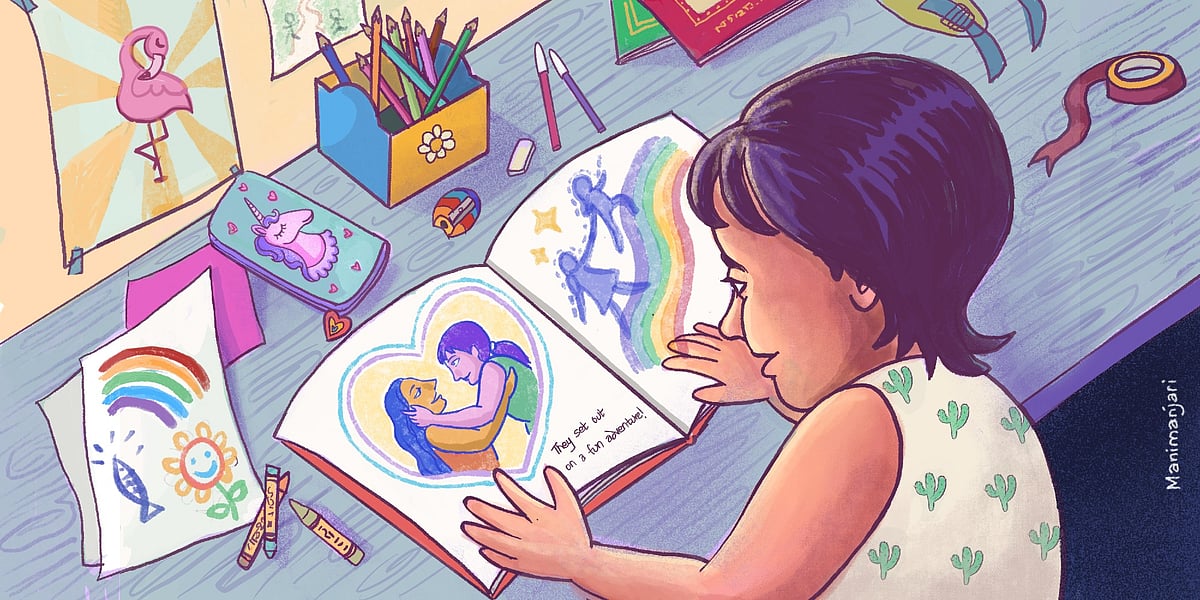
When Siya Vatsa Rajoria started school, she was introduced to the idea that girls wear pinafores and boys wear t-shirts and shorts. Growing up in a home where her parents encourage her to wear whatever she is comfortable in, she felt upset by the sudden imposition. "It was jarring for Siya because we never force her to wear something she dislikes," her mother, Reshma Vatsa, a senior manager with a private bank in Mumbai, told me. "She is a child. She should have the freedom to discover what gives her joy, and express herself."
I was talking to Reshma and her husband Kshitij Rajoria in their fifth-floor apartment in Wadala, a suburb of Mumbai. It is a quiet and green neighbourhood. The walls of their home have turned into canvases for Siya, who is nearly three years old, and are covered with squiggles and scribbles made with crayons of different colours. Siya was dressed that day in a white frock with green cactus plants and a bright red waistband.
Excited to have a visitor, Siya brought her stuffed animals – a bear and an elephant – into the living room where we sat. "Look at this, uncle, look at this!" she said, utterly delighted, holding up every object for my inspection and appreciation. It was a privilege to be trusted and shown such warmth by a child, so I did not ruin the moment by saying that I was not particularly invested in a male or masculine identity and that she could drop the "uncle".
The conversation quickly shifted to books. "When we share books with Siya, I am not sure how much she understands, and what exactly she absorbs at this age," Reshma said. "But we are stunned by some of the things she recalls, and the connections that she makes. Children engage with books in a unique way, and we must let them."