
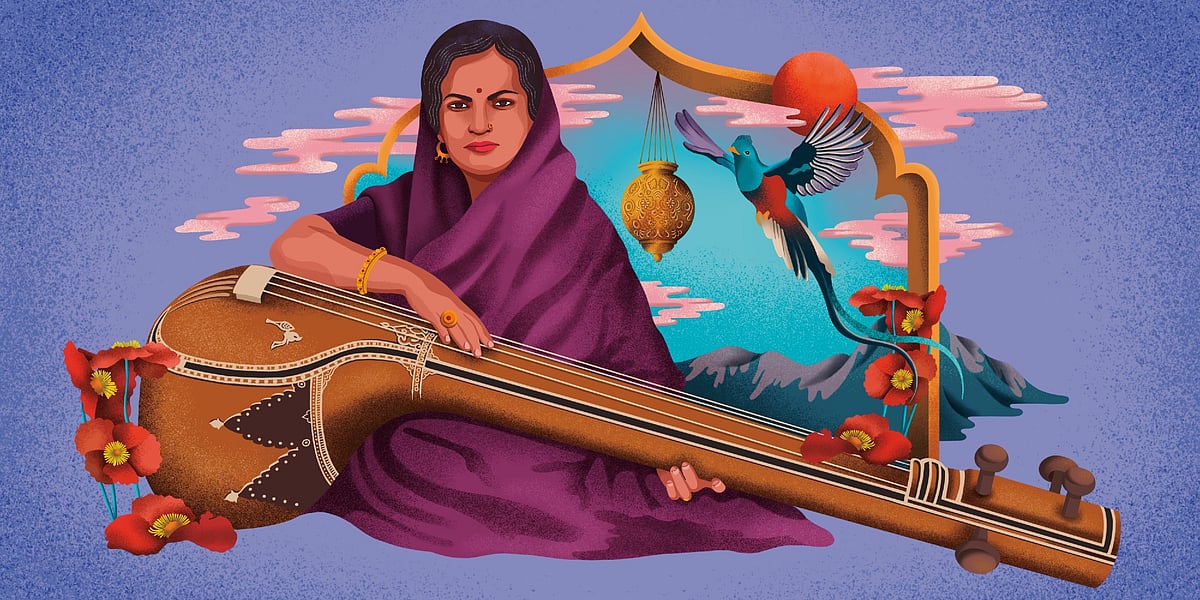
In 1949, when Begum Akhtar sang in a national broadcast of All India Radio (AIR), she was an instant hit. Born in 1914 to a tawaif (courtesan) mother, she performed in her first formal concert in 1934 as Akhtari Bai Faizabadi. She sang in elite gatherings, in royal courts, and performed in Bombay films. Her transition from Akhtari Bai into Begum Akhtar began when she married an English-educated barrister from Lucknow – an event considered both a scandal and a miracle by wider society. Her husband made only one condition: that she would not perform in public, a condition to which she readily agreed. But five years into the marriage, Begum Akhtar experienced mental health issues and her condition deteriorated rapidly. Doctors advised her husband that she might survive if she were allowed to sing. Her 1949 performance at AIR Lucknow met with great success, and as long as she lived, success followed her. She died in 1974, a few hours after performing in a private gathering in Ahmedabad, leaving behind a rich legacy of ghazal and thumri genres of singing associated with tawaif kothas, or salons. By reinventing these genres, and bringing them from kothas to the respectability of AIR and concert halls, Begum Akhtar gave them dignity. One cannot give any account of twentieth-century ghazal and thumri singing without invoking her name.
A closer examination of Begum Akhtar's life and music, focusing on the genres of thumri and ghazal and their intersections with queerness in the context of caste and sexuality in postcolonial India, reveals that her life has been unwittingly connected to larger forces of modernity and contemporary popular culture.
Tawaif subculture and colonial entanglement
Gender-based discrimination runs deep in society, but in the field of music, such discrimination runs even deeper and manifests in complicated ways. The hold of dhrupad over Indian classical music was such that male dhrupad singers fiercely opposed even khayal when it first appeared in India. Khayal singers introduced a strong imaginative component to the highly structured dhrupad form, which was initially resented by dhrupad singers. However, with time, khayal established itself as a classical genre. Not only did women hold subordinate positions in the traditional gharana structure, upper-caste male singers believed that only men could sing classical forms like dhrupad and khayal as it required physical strength and intelligence that only they possessed. They viewed thumri and ghazal, often sung by tawaifs, as inferior forms of music. Nineteenth and twentieth-century reformers actively denigrated tawaifs' music because of its semantic content and its emphasis on erotic fantasy that gave thumri its extra-musical meaning – in sharp contrast to dhrupad, whose structure often organises desire and regulates the mind. Unlike classical forms, thumri invites the listener to wander into non-normative and thus 'dangerous' spaces devoid of the rules that structure society. Therefore, when the British criminalised tawaifs, upper-caste reformers followed suit and enforced British laws and values far more resolutely than the British ever did. Consequently, tawaifs had almost disappeared by the time India gained independence. Only in Bombay films did tawaifs figure, but in a way that further maligned them.