
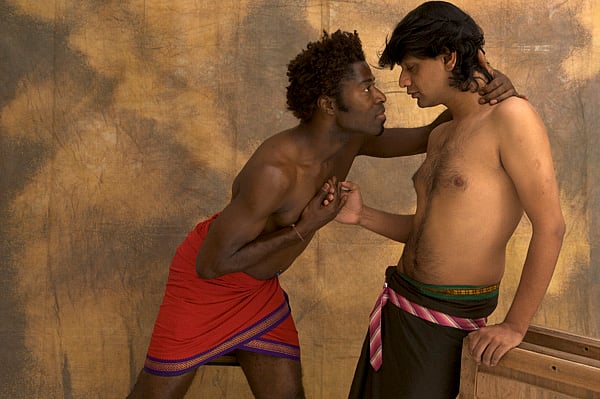
(As India's Supreme Court decriminalised consensual same-sex acts by partially striking down Section 377 of the Indian Penal Code on 6 September 2018, a photo essay from our December 2015 quarterly issue 'The Marriage Issue: Loves, laws, lusts')
In the 1980s, I worked on a series of constructed documentary colour photographs of anonymous gay men in monumental architectural spaces in New Delhi, entitled Exiles. Then, after an absence of thirty-five years, in 2005, I returned to live in New Delhi. People had told me that things were changing and liberalising for the better. The sore point for me had always been the lack of acceptance of my homosexuality and later my HIV status. But both became part of my lifestyle in New Delhi, in ways that I hadn't imagined before living there.
To mark this change I embarked on a project entitled 'Mr Malhotra's Party' in 2008, a set of portraits of out and proud queer young men and women that I had come to know. Each photograph is titled with their real names. We took the pictures outside with the formality of a studio in mind. It gave me a chance to illustrate the public spaces queer people inhabit in New Delhi, and the everyday quality of these situations; people were not hiding somewhere in a park or a monument as they had been in 'Exiles'. Although the portraits have grown in number, and now, cross class boundaries and include transgender people, they are still focused on New Delhi. You can infer by the exclusions, such as older men and working class women, those who still don't feel comfortable about being photographed.
Momentous changes took place during 2008-2009 in New Delhi. There was the first LGBT Pride parade in 2008 and the reading down of the notorious Section 377 that made homosexuality a criminal activity. In a landmark judgment, the Delhi High Court on 2 July 2009, struck down the provision of Section 377 of the Indian Penal Code, which criminalised consensual sexual acts of adults in private, holding that it violated the fundamental right of life and liberty and the right to equality as guaranteed in the Constitution.