
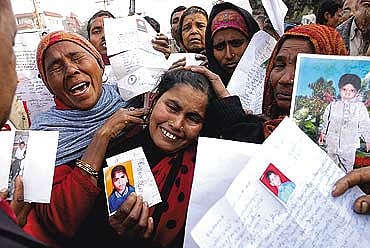
It's a village surrounded by villas. Nithari. A "well-concealed eyesore", according to one newspaper account. It is inhabited by migrant labourers, some employed as domestic servants in the surrounding bungalows and some as drivers and fruit vendors. About two years ago, the children of the village began to go missing. Family members reported to the police but received no response. The parents of one of the missing girls were told that she must have eloped. Despite the number of complaints, the police did not register even one case. Newspaper reports now suggest that the villagers knew that something was amiss in D-5 of Sector 31, Noida. They suspected the cook who stayed in that house – Surinder Kohli, also known as Satish – of having designs on their children. Homeowner Moninder Singh Pandher was rarely seen and neighbours had always been discouraged from entering his house. When 20-year-old Payal went missing, investigations led the police to Surinder. And then, unexpectedly, out tumbled confessions of sexual assault and the murder of six of the village's missing children.
As the media picked up the story, it emerged that Moninder had studied at the elite institutions of Bishop Cotton School, Shimla and St Stephen's College, Delhi. He drank a lot, said one of his relatives during a television interview; he was absolutely fine, said a friend from school on NDTV channel's We the People programme. He was employed in Joseph Cyril Bamford, a construction and agricultural equipment manufacturing company, was married but separated from his wife, and was a loving father – who could not have done such a thing, said his son. Television programmes described the incident with the headlines 'Children of a lesser God' and 'Noida Killings: India's Shame'. Upon finding the remains of their children, the aggrieved and outraged parents attempted to destroy the house. "There was blood in the bathroom inside the house," said one of the parents; "The police don't want us to go in." In the midst of all this, the younger brother of Uttar Pradesh Chief Minister Mulayam Singh Yadav, Shivpal Yadav, who visited Nithari to offer condolences, said, "Such incidents keep on happening." Such a blasé statement does seem fitting after the neglect with which the children's disappearances were treated for so long.
The news regarding Nithari has changed. Nithari has entered the imagination: it is now a landscape of the mind. It has subsumed the accused. The case is no longer about Surinder and Moninder Singh. Could Nithari have happened without them?
A question dogs the mind: Why didn't the police do anything? According to some reports, the residents of the village even hired a private investigator when their children went missing. He too pointed at Surinder and Moninder. Even then, the local police thana was not bothered. On the episode of We the People devoted to the Nithari killings, Director General of the Bureau of Police Research and Development Kiran Bedi lamented glaring oversights such as this, and suggested that they occur because the police are not trained. Another panelist was Rajat Mitra, a psychologist heading Swanchetan, an NGO that works with the Delhi Police in the area of crisis intervention. He said that when children go missing in many other countries, the police are immediately on the lookout for paedophiles. Mitra felt that people like Moninder are diabolical in nature, irrespective of their socio-economic backgrounds. Was background important here?