
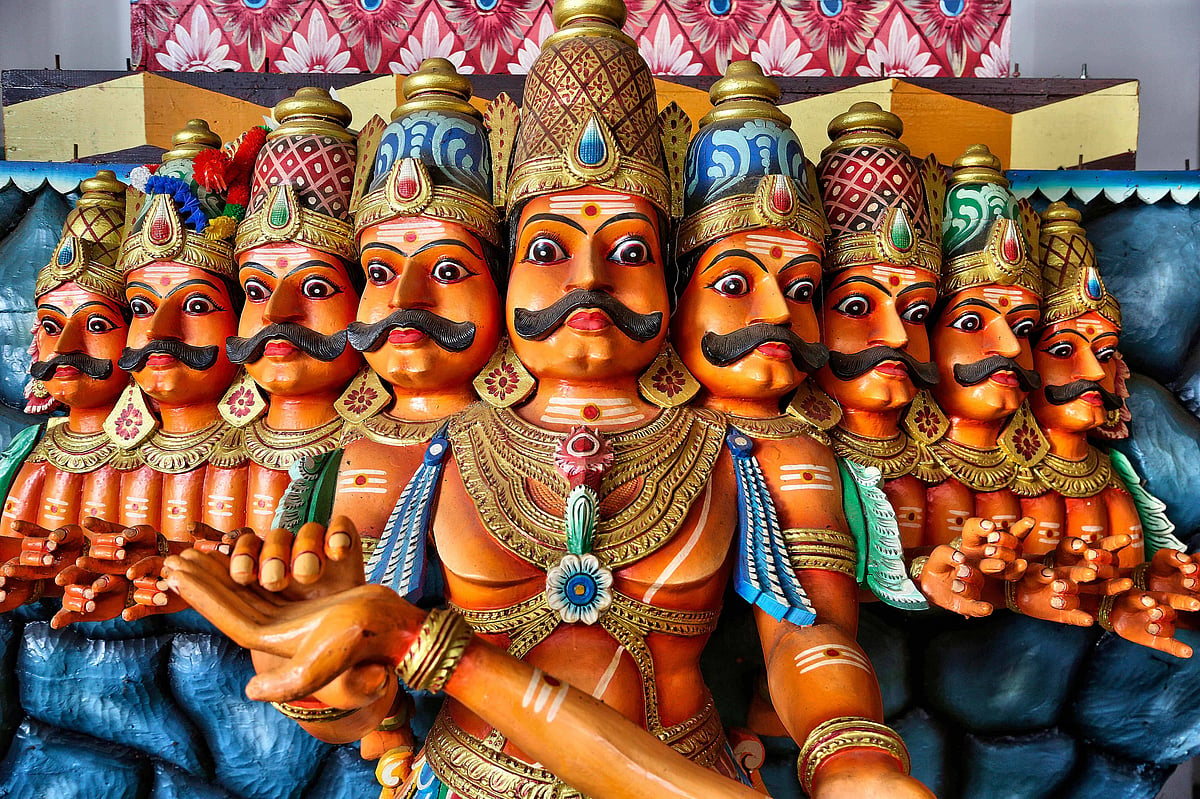
Ravan’s place in the Sinhala Buddhist consciousness is somewhat ambivalent. He is supposed to have lived in pre-history, before the arrival of Prince Vijaya in 6th century BCE and Buddhism’s advent on the island. As such, he was not a Sinhala Buddhist king. In the Ramayana, the ancient Hindu epic, Ravan is often depicted as a demon-king who ruled over Lanka, and some other texts describe him as a committed follower of the Hindu deity Shiva. Yet modern-day chauvinist groups such as the Ravana Balaya have attempted to co-opt Ravan and the mythology around him to promote an ultra-nationalist agenda geared to prop up the Rajapaksas, Sri Lanka’s Sinhala Buddhist strongmen until their dramatic fall from power in 2022. A series of popular Sinhala-language books in recent times by the writer Mirando Obeyesekere has further established Ravan as a central figure in the Sinhala Buddhist nationalist discourse.
Alongside this resurgent interest in Ravan, there has emerged Ravan-centric tourism in places popularly associated with various legends of the Ramayana, especially in the central highlands of Sri Lanka: Nuwara Eliya, Horton Plains, Ella and such. There is even a theory which posits that the earth in Nuwara Eliya is black as it contains residue from nuclear tests carried out by Ravan. The Divurupola Temple, close to Welimada, is supposed to be the site where Sita faced her “Agni Pariksha”, the trial by fire where, as consort to the hero Ram, she had to prove her chastity after being spirited away by Ravan. Hakgala Gardens is famous as the place where Sita was kept after she was abducted, and where Hanuman, dispatched by Ram, first encountered her. The island chain that traces a path between the southern tip of the Indian mainland and the northern tip of Sri Lanka is meant to be the Rama Setu, the bridge Ram constructed to reach Lanka to rescue Sita after besting Ravan in battle.
A recent commercial by the state-owned Sri Lankan Airlines invites visitors to a “Ramayana Trail” in Sri Lanka. It shows an elderly Indian woman, apparently Hindu, relating to her grandson the mythic battle between Ravan and the prince of Ayodhya, Ram. The video juxtaposes images from a children’s-book version of the Ramayana with footage of actual sites in Sri Lanka, erasing any distinction between mythology and history. This is calculated marketing: the clearest target audience are moneyed Indian Hindus increasingly and uncritically invested in Ram, especially after India’s Hindu nationalist government under Narendra Modi has made it a point to build a temple to Ram on the site of a razed Mughal-era mosque. Yet this same audience, weaned on the dominant Indian telling of the Ramayana, also sees Ravan as the villain to Rama’s hero. In the pursuit of tourists and much-needed tourism revenues, then, Ravan’s putative herohood in the Sinhala Buddhist telling is conveniently put to one side.
The complications hardly stop there. Sunela Jayewardene’s The Line of Lanka: Myths and Memories of an Island (2017) and Ravana’s Lanka:The Landscape of a Lost Kingdom (2024) are, to a great extent, focused on Ravan mythology although Jayawardene would no doubt eschew the use of the word “mythology”. Jayawardene’s framing of Ravan is meant to challenge the dominant Vijaya- and Mahavamsa-centric traditions of understanding Sri Lankan history and archaeology, especially in academic circles.