
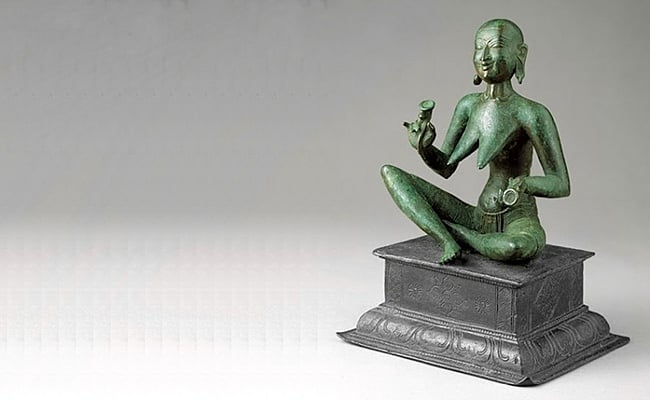
Between the 5th and 6th centuries in the region now known as Tamil Nadu, emerged an intensely emotional devotionalism focussed on one of two gods, Vishnu or Shiva, that eventually came to be known as the Bhakti movement. A number of saints composed impassioned poetry, praising their chosen deity as immanent in sacred centres across the Tamil land. Temple inscriptions show that many of these hymns were popular among the masses. Myths and legends grew up around the saints as well, and they too became objects of popular veneration. Hagiographies of the saints were composed in both the Vaishnava and Shaiva religious traditions in the early centuries of the second millennium. It is likely that several of these canonised saints were not necessarily historical figures, but creations of the popular imagination. And while some of the poet-saints are evidently historical in that they have left behind compositions, the stories we know of them may be entirely mythical. Interpreting Devotion: The Poetry and Legacy of a Female Bhakti Saint of India focuses on one such saint, called Karaikkal Ammaiyar in popular tradition, on her poetry, and on how the two have been understood by others. For the author, Karen Pechilis, these three foci converge towards a central question: how devotion is understood and interpreted.
The poetry under consideration is the earliest of the Tamil Shaiva Bhakti corpus; in three of the four poetical compositions, the poet signed herself/himself Karaikkal pey, ie., ghoul from the town of Karaikkal. While this poet lived sometime in the 6th century, it was in the twelfth century that a Chola court poet, Cekkilar, composed his hagiography of 63 Shaiva saints. All but three of these canonised saints are men, and two of the women saints seem to be included in the list essentially due to their association with one or the other of the male saints. Karaikkal Ammaiyar is therefore a particularly interesting subject of study as she is apparently the only female poet-saint in the Shaiva hagiographic tradition.
In several poems the poet speaks of herself – and here I am following both the millennium-long Shaiva tradition and Pechilis herself in continuing to use the feminine pronoun – as watching the fearsome dance of Shiva in the cremation ground in Tiruvalankatu, surrounded by macabre, flesh-eating ghouls, at least some of whom are specified as female. Though none of the signature verses in the hymns identify the author as a woman, Cekkilar decided, for reasons we cannot fathom, to treat this third-person representation of the female ghoul as a self-portrayal by the poet, and accordingly drew a portrait of a woman who was transformed from a beautiful wife to a skeletal, ghoulish creature who chose to spend her days – and nights – celebrating Shiva's dance in the cremation ground.
Pechilis demonstrates why this identification is problematic through an examination of the subjectivity of the poet and of the ghoul as seen in the poetry itself. Drawing on insights from important feminist studies, she also shows that the themes and images in the poetry do not resonate with those by other women authors. While Pechilis does not pose the question of why medieval hagiography chose to attribute feminine gender to this poet, it is significant that she engages with this issue at all, for most scholarly works on Karaikkal Ammaiyar that I am familiar with have tended to take Cekkilar's account at face value.