
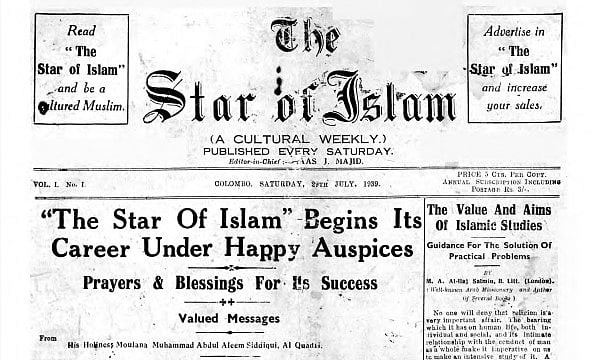
Maritime trade routes passing through the ports of Sri Lanka helped spur the growth of pan-Islamic consciousness within the island's Muslim communities. Researcher and historian Ronit Ricci marks the opening of the Suez Canal in 1869 as a keystone event which eased the Hajj pilgrimage route from Southeast Asia to Mecca, with many pilgrim ships docking at ports in what was then British Ceylon. Moreover, the colonial experience of religious repression, the arrival of Arab political exiles, and the emergence of the press as a tool for religious and cultural assertion arguably intensified the appeal of pan-Islamic identity for Ceylon's Muslims. Increasingly emphasised by Muslim-owned presses across Asia, this pan-Islamic discourse emerged in a local press that briefly engaged readers well beyond the island's shores.
In the late 1800s and early 1900s, a number of publications by Ceylonese Muslims began to be circulated around the island. These included newspapers like Alamat Langkapuri (which was published the same year the Suez Canal was opened) and Wajah Selong (Light of Ceylon) from the Malay community, and Muslim Nesan (Muslim Friend) and The Ceylon Mohammadan by the Moor community. These distinctions among the island's Muslim people had been shaped by ancestry, linguistic and cultural practice, and colonial state classification.
The complete archives of the Star of Islam – an English-language weekly which ran every Saturday from July 1939 to September 1940 – was rediscovered by researchers in September 2018 in the archives of the Sri Lanka Malay Association in Slave Island, Colombo. The location is not far from Glennie Street, where the paper's press once stood. Maas Juragan Majid is the custodian of the archive, a former president of the Sri Lankan Malay Association and namesake of the Star of Islam's founding editor, his uncle. Majid's timeworn yet meticulously preserved collection of his uncle's newspaper offer a unique glimpse into an era when pan-Islamic political consciousness was a rising phenomenon across Asia and Africa.
Spirituality and connected readership