
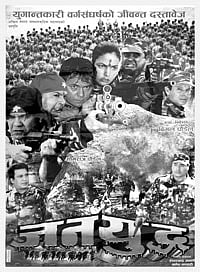
Eight in the morning on a weekday: cheering erupts at scenes of Maoist cadres storming a prison. More enthusiastic applause greets the fighters as they free their friends, to the beats of the Mission Impossible theme song. On the other hand, the title song of the movie, penned by the party chairman and first prime minister of the Federal Democratic Republic of Nepal, Pushpa Kamal Dahal (aka 'Prachanda'), received a more muted response. The aisles of the 1000-seater Bishwa Jyoti Cinema, just down the street from the Narayanhiti Palace in Kathmandu, are packed, even overflowing. The occasion: a special screening of the Communist Party of Nepal (Maoist)-produced film Jana Yuddha, 'People's War'. With the screening taking place soon after the Maoists swept the Constituent Assembly polls in April, interest in the film is understandably high. Kathmandu which, unlike much of the rest of Nepal, remained largely insulated from regular contact with Maoist cadres during the decade-long conflict, is curious about this new entity.
As it happens, the audience left the theatre almost three hours later, but without much new insight. Following the lives of a few individuals in a particular village, the film captures the ways in which the brutality of the state converts the people to Maoist sympathisers or activists. Interspersed with this narrative is the story of the cadres themselves, as they go about interacting with the villagers and plotting attacks against the state. Scene after scene depicted the Maoists' struggle to liberate the people from the clutches of a corrupt state machinery, which is shown as the perpetrator of unwarranted violence against the powerless. This portrayal is neither unexpected nor, indeed, misleading. As is true of leftist revolutions elsewhere, the armed struggle in Nepal was certainly a response to the state's failure to do its job. But the villains of this film are small-time district officials – not the 'oppressive state' against which Marxist jargon rails before the proletariat. Interestingly, land owners and businessmen exemplifying the oppressive 'feudal' or 'capitalist' classes do not appear in the film. Despite the locale, however, Jana Yuddha oddly does not situate the roots or the evolution of the conflict in the specific Nepali context. In fact, if one were to alter the set, cast and language, the movie could easily be about the Naxalites of Chhattisgarh or the Shining Path of Peru.
Such general representations of the decade-long conflict appear to make up the spate of Maoist films that have been released since the party joined mainstream politics in 2006. Though actual footage taken during battles, victory rallies and speeches by the leadership have been made into documentaries by the Maoists, the films in question here use actors, background scores and storylines. Movies such as Awaaz (Voice), Shahid (Martyr) and Paribartan (Change), all produced by the Akhil Nepal Janasanskritik Mahasangh, the party's cultural wing, revisit the same overarching themes. Inevitably, these stories are about the harassment, rape and torture of the innocent by local government forces, as the Maoists wage their battles against such 'regressive' elements. In fact, Lal Salaam, written by current Maoist MP Janardan Sharma ('Prabhakar'), is the only production that does not wholly follow this trend. Envisioned as a kind of fictionalised documentary, the film outlines the evolution of the Maoist movement from the time the party went underground till it emerged to join the People's Movement of April 2006 against the autocratic monarchy. Still, this story too is presented as a clear-cut battle between good and evil.
Of course, an argument can be made that, as commercial undertakings, these films were created to entertain, to tug at the heartstrings with their starkly drawn battle lines – not to explore the nuances of the conflict. The prominence in many of these narratives of romances between the cadres, complete with dance numbers to revolutionary lyrics, certainly does much to justify this point of view. Or it could be that revolutionary romance was a real part of the 'People's War'. These films have also been recognised on the awards circuit. During the National Film Award ceremony this year, where the prizes were handed out by now-Prime Minister Dahal, Jana Yuddha received five awards, including best film and best actor, while Lal Salaam won two trophies for best art and best action direction. But these films have not been commercially successful. While the special screenings organised by the CPN (Maoist) are well attended, regular sales of both theatre tickets and DVDs, which cost anywhere from NPR 250 to 400 (USD 4 to 6), have been less than spectacular. Again, this is perhaps not surprising. As it is, the Nepali film industry, vastly overshadowed by the popularity of Bollywood, is faring poorly. Seeing as how the Maoist-produced films released thus far do not even outshine the average Nepali film in terms of acting, cinematography or script, most viewers have little reason to watch them, added to the didacticism that is a part of the baggage.