
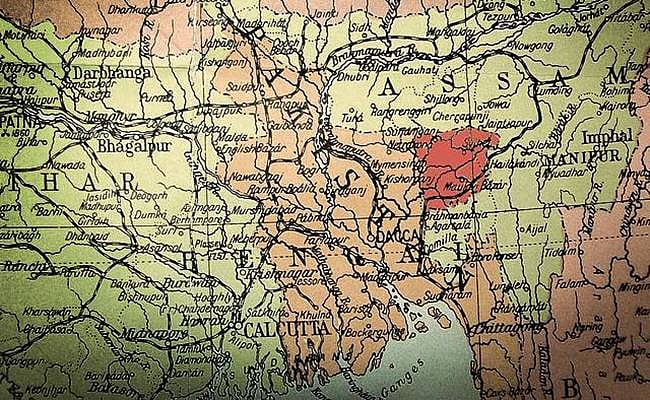
Sixty-five years after Partition, the scholarship that event generates is varied and contested. Now more than ever before, writers and researchers are questioning the heavy focus on Punjab and Bengal at the expense of the third site of Partition – colonial Assam, and particularly the region of Sylhet, which elected to join East Pakistan in a 1947 referendum. The history of Sylhet opens up new complexities beyond the typical discourse that sees Partition as primarily a matter of religious communalism.
The study of Partition's more narrowly regional dimensions is a recent development. The first Partition historians – Michael Edwardes, Penderel Moon, David Page, V P Menon, G D Khosla, and others – focused on decolonisation and the high politics of the division of India, with a core focus on Punjab. Punjab had captured the popular imagination because of the enormity of Partition violence there, which completely clouded this first phase of scholarship. The 1960s saw another spurt of Partition studies, including debates on the emergence of communalism, and also the publication of the memoirs of many key political players with a hand in the events of 1947. Still, the main focus remained on Partition in the Indian west. Meanwhile, nationalistic scholars in India engaged in glorifying the new state and eulogising the post-Partition leadership. Little emerged on Partition's impact in areas distant from the 'core' of north India and Punjab; Partition became a largely Punjabi experience and not, as it actually was, a story of both east and west India. Even until recently, many professional historians who have contributed immensely to the study of Partition – Mushirul Hasan, Ian Talbot, Stanley Wolpert, David Gilmartin, Alok Bhalla, Anita Inder Singh, Ravinder Kumar – have been loath to engage with the Partition experience in the east.
In the 1980s, studies of genocidal violence after the anti- Sikh riots again revived interest in Partition. This time, scholars took a closer look at the Bengali experience, but Assam and Sylhet still lay outside mainstream concern. Even as late as 2006, an article titled Analysing Partition: Definition, Classification and Explanation by the historian Brendan O'Leary stated that, "the Partition of India is also known as the partition of Punjab and Bengal, and was executed by the Radcliffe Commission."
J B Bhattacharjee's Sylhet: Myth of a Referendum (1989) was among the first works to focus on Assam as the third site of Partition. At the time, his was a voice in wilderness. More scholarship on Sylhet finally emerged after 2000, with Anindita Dasgupta's Denial and Resistance (2001) and Remembering Sylhet (2008), Bidyut Chakrabarty's The 'hut' and the 'axe' (2002) and The Partition of Bengal and Assam (2004), and Nabanipa Bhattacharjee's Unburdening Partition (2009). Scholarly interest has increased further with several relevant articles published in the last few years.