
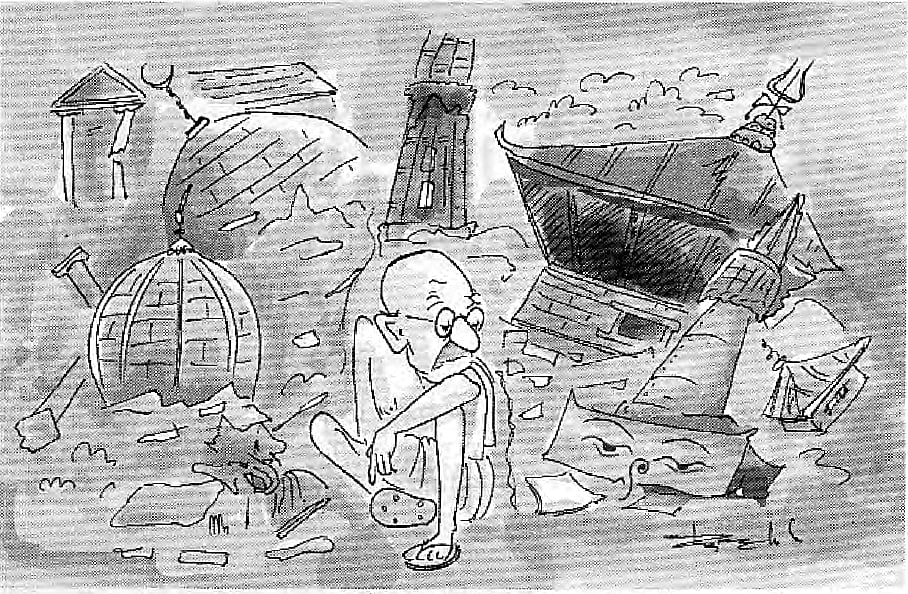
Attribute it to the power of the Empire, but Southasians have no hesitation in embracing Adam Smith, Ayn Rand, Marx or Mao as their own. In one country where the Turkish Ataturk is a role-model of "enlightened moderation", the proponent of real enlightened moderation is an 'Indian'. In the countryside of another Southasian nation where the guns rule, the epitome of courage with conscience is seldom remembered. Is it a deep-seated inferiority complex which makes Southasians oblivious of the legacy of Mohandas Karamchand Gandhi? From South Africa to the United States, proponents of peaceful protests draw their inspiration from the pioneer of ahimsa. But most Southasians look at him through the tinted glasses of bigoted nationalism and see a nationalist 'Indian'. Within India itself, Gandhi is consigned to history textbooks and his values dismissed as romanticism in the power corridors of Delhi and the state capitals. However, more than a concerted effort to rehabilitate his memory, it is the needs of the time that will establish the primacy of Gandhi as a Southasian ideal who foresaw the complexities of the region and devised a middle path to face the challenges of the future. His legacy is a shared Southasian heritage and the region will discover his relevance as it enters into yet another turbulent phase in its history.
These are sanguine times for some Southasians. Unocal alumnus Hamid Karzai has declared the dethroned King Zahir Shah the Father of the Afghanistan nation, once destroyed and then rebuilt to the specifications of US Pacific Command. Bangladesh is happy being at the centre of SAARC and BIMSTEC, two sets of idiosyncratic alphabet mixes that stand for largely ceremonial organisations. Bhutan is enthralled by the prospect of democracy which King Jigme Singye Wangchuk has promised to introduce by 2008. The Burmese junta has just shifted its capital to correct the feng shui and entrench itself further. India isn't exactly shining, but some Indians are certainly gloating over the prospect of becoming the back office of the world in the next one, two, or three decades depending upon whether you are talking to a free-market fundamentalist, a socialist planner or a self-proclaimed pragmatist; they all seem to share the same brahminical dream of making it big without getting their hands dirty.
Pakistan is content with a general-in-sherwani espousing enlightened moderation on the strength of a couple of F16s with nuclear capabilities. Nepal is rediscovering its golden days of "monarchical democracy" by importing Chinese arms. President Mahinda Rajapakse of Sri Lanka is proud to have ridden the wave of anti-LTTE sentiments in the South even though his victory has put the peace process of Serendib in peril. All in all, the power elite of Southasia is happy and content. Very few, too few it seems, have the time or inclination to remember the frail old man in dhoti striding the length and breadth of the Subcontinent with a toothless smile on his face. But just as these are the best of times for some, there are many others for whom these are the worst of times. In a region where paradoxes are the rule rather than the exception, the Dickensian metaphor of two cities is the most accurate description of everyday reality. Just below the shine of the thin silver lining, there is the reality of an unpredictable dark cloud hovering over Southasia.
The al-Qaeda organisation recently claimed, with some justification it seems, that it still holds large swaths of Afghan territory under its control. An Islamist upsurge threatens Bangladesh, a country that grew out of violent conflicts, first for religious homogeneity and then for independent cultural identity. The racial regime of the Drukpa in Bhutan has refused to mend fences with the Lhotsampa it forced to flee. The deepening grip of the Burmese junta is enticing its neighbouring countries into dealing with an abhorrent regime. The democratic decay in the biggest democracy of the world has become quite alarming: members of Parliament guzzle local development funds and accept bribes in order to raise questions in the Lower House. The royal-military rule in Nepal is digging in its heel. The unity of Sri Lanka's people stands threatened. The dilution of Tibetan culture will be a great loss of all human heritages, but most Southasians appear blissfully unaware of the processes that have been unleashed by Beijing upon the roof of the world.