
Awadhendra Sharan's In the City, Out of Place: Nuisance, Pollution, and Dwelling in Delhi, c. 1850-2000 is without a hint of doubt one of the most important books on Delhi to have come out in the past few years. Sharan is a meticulous researcher, who brings discipline and a wealth of scholarship to bear upon his subject, namely, colonial and postcolonial Delhi. Specifically, this book seeks to understand practices and governance around key arenas of the city. The first of these is water. Sharan looks at the story from both 'ends' of the water cycle in the urban settlement – from the availability of water from canals, rivers and underground sources to the variety of distribution networks leading to the city's various thirsty populations; and conversely, as he terms it, the "flow away" of water from homes and factories as sewage and sullage. In both cases, Sharan notes that valuable opportunities to create an environmentally sustainable regime of water were squandered several times in Delhi, even as an understanding of the state as responsible for both clean water and a city free of sewage was put into place.
Second, Sharan documents changing practices of animal slaughter in modern Delhi, tracing the tortured evolution of the modern slaughterhouse. Complicating the matter are modern notions of the trauma of open animal slaughter, seen as unfit for civilised folk, especially their children; and conversely, the peculiarly colonial phenomenon of the rise of organised community 'sensitivities' around slaughtering practices. Since the late 19th century, as documented by historians like Peter Van Der Veer, a vigorous cow protection movement emerged amongst largely upper-caste vegetarian Hindus, led by organisations like the Arya Samaj. This movement, with its many offshoots in places like Awadh, Rohilkhand, Bombay Presidency and Punjab, targeted the 'evil' of beef consumption, especially by Muslims. Subsequently, religious processions that included ritual animal sacrifice amongst Muslims, often of the goat and not the cow, attracted these communal mobilisations.
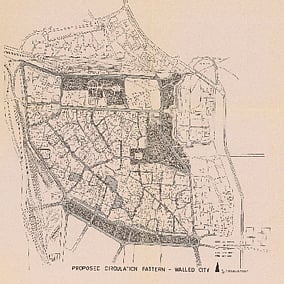
Third, Sharan examines the history of spatial planning in the city – a process that has been framed around anxieties of congestion, chaos, and illegality. He examines the growth of housing, slums and industries in the old and new cities, recording the shifting paradigms of governance that seek to regulate this growth. The final chapter on pollution analyses industrial, vehicular and other forms of pollution in Delhi. He notes the major transformation in this realm from the ideas of congestion, nuisance and crowding that generated exclusively spatial solutions (banishing polluting industries and pollutants from the city to the outskirts) to defining clean air as a fundamental right for all citizens, and finally to the partial establishment of the "precautionary principle" through judicial activism. The precautionary principle – often employed in environmental law – states that if an action or policy has a suspected risk of causing harm to the public or the environment, then the burden of proof to show that it is not harmful falls on those taking the action.
As Sharan puts it early on in the book, the idea is not simply to see but to see how we see: "The book, thus, considers not only the urban world that is historically available to us, but also the words through which these worlds were made up and seen." Sharan's gaze is trained not simply on the material reality of the built structures and practices that mark the three areas mentioned above (sewers and pipes; abattoirs and landfills; industries and vehicles), but also on the ways in which these areas have been understood, imagined and governed in colonial and postcolonial Delhi – the words and concepts used, the forms of knowledge, expertise and terminology developed, and finally, the legal scaffolding erected around it. Indeed, there is practically no domain of urban life in postcolonial Delhi that is left unexamined by this work.