
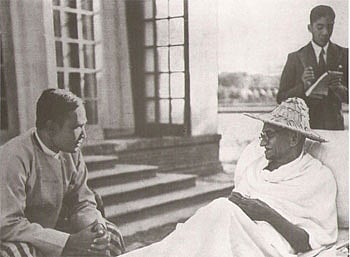
Over the monsoon of 1946, as the contest between the Congress Party and the Muslim League was determining the fate of the Subcontinent, a very different fortune for colonial India's erstwhile province of Burma was also being framed.
A little a more than four years earlier, the Fifteenth Imperial Army of General Shojiro Iida had driven the British out of Burma, turning the country into a gigantic battlefield in a vicious fight that led to the complete destruction of nearly every city and town. The radical nationalist fighters under Aung San had first collaborated with the Japanese, and then in the spring of 1945 turned against their mentors, Aung San declaring himself an Allied commander and head of a provisional government.
The returning British at first chose to sideline Aung San, planning for a long period of reconstruction, elections and gradual transfer of power. But Aung San upped the pressure, attracting huge crowds of supporters and quietly threatening a mass uprising. Jawaharlal Nehru insisted that the Indian Army would not be available to quell a Burmese revolt and the British, their hands full with Palestine and India, decided that the prudent thing to do was to quit Burma.
And so they did, in January 1948. But six months beforehand, Aung San, together with most of his Cabinet, had been gunned down in a still-mysterious terrorist attack. The most senior Burmese in the Indian Civil Service, U Tin Tut, a King's Commissioned Officer and slated to head the new Burma Army, would soon be killed as well, by unknown assailants. Even worse, the country's leading communists – including many of the brightest and most capable of their generation – had gone underground and were plotting rebellion. By the time the last of the Yorkshire Light Infantry had sailed away from Rangoon harbour to the tune of "Auld Lang Syne", Burma was already at civil war – a war that has continued without interruption to this very day, the longest-running armed conflict in the world.