
On 15 August 2009, a policeman was suspended in Dantewada in Chhattisgarh, the epicentre of one of the fiercest ongoing conflicts between India's Maoists, the armed vigilante group Salwa Judum and the security apparatus of the state. One might have been forgiven for concluding that the suspension was punishment for the rampant human-rights violations that had been taking place in the state. Instead, the action against the constable, Bimaram Poyam, proved to be a farcical demonstration of the fragility of Indian democracy. Evidently, the hapless official had fixed the national flag incorrectly, such that it unfurled upside-down during the Independence Day flag-hoisting ritual. An official inquiry was immediately ordered, and punishment meted out.
Contrast this with the 'fake encounter' of Sanjit, a former insurgent, on 23 July in Imphal. Crossfire in a crowded part of Imphal leaves a young pregnant woman named Rabina Devi dead. Minutes later, in another part of the city, police drag Sanjit into a pharmacy and shoot him in cold blood, later claiming that he was responsible for the earlier firing (see Himal Sept 2009, "Snapped").
Thereafter, it took ten days before a judicial inquiry was even ordered, and the policemen involved suspended. Yet this is but par for the course in Manipur, where a longstanding insurgency has meant that the already marginalised people suffer under draconian security legislation such as the Armed Forces (Special Powers) Act of 1948, the AFSPA. It is against this law – which allows security personnel operating in the so-called 'disturbed areas' to shoot and kill on sight on mere suspicion – that many campaigns have been launched over the past half-century. Indeed, by early winter, schools in the Imphal Valley that were shut down in protest of the 23 July killings had yet to re-open. But it is one quiet woman on an indefinite hunger strike who has truly succeeded in drawing attention to this forgotten corner of India.
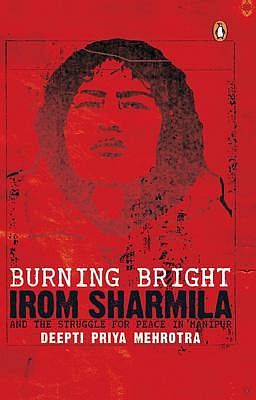
Irom Chanu Sharmila, slight and curly haired, her eyes luminous and intense, is perhaps not typical heroine material. It is a complex turn of circumstance, then, that a book such as the new Burning Bright could run the risk of creating an icon out of an ordinary woman who is simply following her conscience. Indeed, by all accounts, the international recognition and awards Sharmila has received have not swayed her primary motivation. Often compared to Mohandas Gandhi due to her use of the fast as a strategy, her slow, measured tones, sometimes little more than a whisper, have proven more effective than fiery speeches. Also in common with Gandhi, it was Sharmila's abhorrence for violence that turned her into a fierce campaigner against militarisation.