
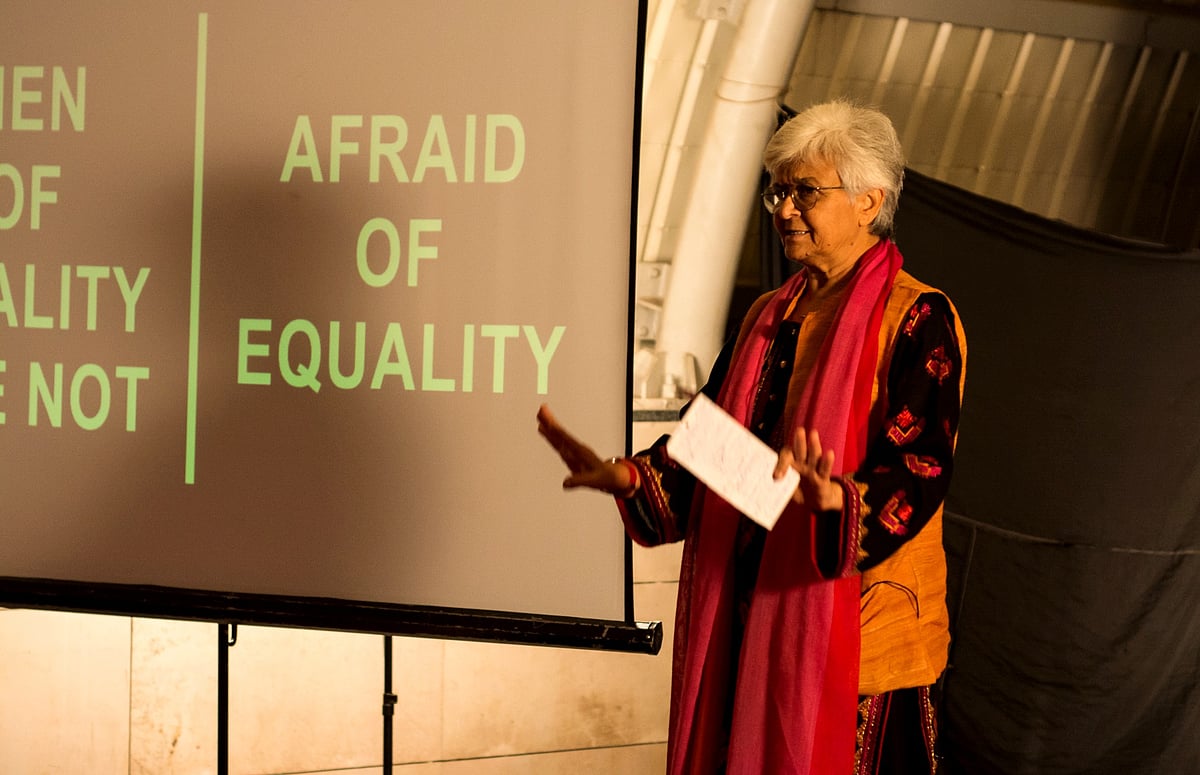
Kamla Bhasin always called herself one of India's 'Midnight Generation', a reference to those born at the time of India's Independence. Prime Minister Jawaharlal Nehru's invocation of freedom at midnight later found its way into Salman Rushdie's award-winning novel Midnight's Children. Told from the standpoint of Saleem Sinai, born precisely at the time the clock struck midnight, the novel is about a generation that lived to see India as they knew it disintegrate before their eyes. Considered a seminal example of magical realism in Southasian English-language writing, the novel takes us through the violence, the contortions, the messiness, and the heartbreak that is independent India. Written at the time of the Emergency in the 1970s, it would, in the end, tell only half the story.
Kamla Bhasin was indeed one of 'Midnight's Children', carrying with her the ideals of that generation: a search for justice, equality and self-respect, after having left a colonial past where Southasians were denied their basic dignity. Non-violence was her core belief and the Partition her defining experience. From this reality came a sensibility determined to transform the world, bring peace between India and Pakistan, and see social justice within India's borders and beyond. Asceticism and self sacrifice were motivational forces while handspun cotton and local products filled her home and her programmes. With Kamla's death, we are again reminded how that era is coming to an end, replaced by religious nationalism, economic inequality and social extremism which cut to the core of her being in the few years before her death.
Kamla was a daughter of a doctor who worked in rural India, especially in Rajasthan. Her first memory of social injustice was caste bigotry and violence; the caste privilege, the discriminatory use of wells and the denial of essential water to the Dalit community that she witnessed mortified her. The outrage she felt at these practices stayed with her for a lifetime, and she spent a great deal of her time challenging the caste system, engaging in cross-caste programmes, and working toward Dalit rights and self-respect in the villages. Before she gave her full time to the women's movement, her work at the Food and Agriculture Organisation and in Bangladesh was about development and dignity in the rural areas.
Partition was the other childhood memory that stayed with her and became an obsessive reminder that her nation was born in blood. She threw herself into peace initiatives and peace programmes between India and Pakistan. She created strong bridges between Indian and Pakistani women and included Pakistani participants in all the activities of Sangat, an organisation she set up to train and mobilise Southasian women to pursue activism in their own countries. Her death was mourned deeply in Pakistan, where the enmity between states prevented the full expression of loss and solidarity across borders.