
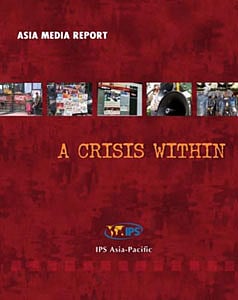
A controversial cover of The Economist last year asked, with not much self-reflexive irony, "Who killed thenewspaper?" The suggestion of death seems, in hindsight, grossly exaggerated. Asia Media Report: A crisis within explores a more specific and far-reaching concern: the death of news as we know it.
This is familiar ground. The large-scale takeover of news outlets by big-money corporations and the concomitant rise of infotainment to cater (advertisers insist) to the needs of a mythical dumbed-down 'market' have been widely lamented, as have the problems of cross-ownership and consolidation, and the challenges of reporting and publishing news under repressive regimes or in otherwise hostile environments.
But this multi-part, multi-author report, commissioned and published by Inter Press Service Asia-Pacific, is not just a hand-wringing ode to a lost cause. It presents articulate essays on specific trends in countries across the region, including how news for people living in Burma is produced in exile, and how entertainment in Pakistan comes increasingly in the form of spiritual teachings that are both arch-conservative and designed to attract urban youth. Also included are assessments of the 'media environment' in different countries, such as under dictatorship in Nepal, and amid the lure and power of money in India and Thailand. And in each analysis, the report makes strong empirical arguments for its premise: that free, responsible media is indispensable to the success of any democracy.
Political repression is the straightforward part of the story. Under next-to-impossible conditions, Burmese journalists in exile produce news for their fellow citizens back home. During King Gyanendra's dictatorial rule, Nepali journalists fought back with metaphorical or absurd editorials, printed gibberish when a defiant blank space was not allowed, sang the news on FM radio, and more.