
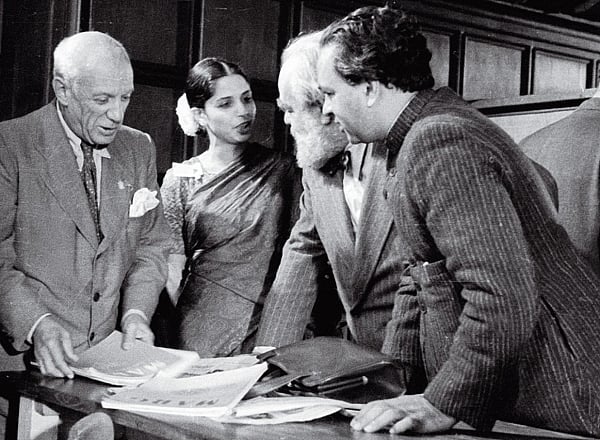
In 1946, in Bombay, a group of young intellectuals that included the Indian writer Mulk Raj Anand, the German architect Otto Königsberger, and two Ceylonese sisters – the art historian and writer Anil (Marcia) de Silva-Vigier and her younger sister, the architect Minnette de Silva – founded the arts and culture magazine MĀRG. The beginning of this venture was fraught with financial issues – the group had to find subscribers and advertisers to fund the first issue – but support in the form of J R D Tata's offer of "seven ads and two rooms" enabled MĀRG to establish itself as an authority on Indian – and Southasian – art and architecture, and introduce contemporary Western architectural movements and styles to an Indian audience.
The de Silva sisters belonged to a politically active Burgher Sinhalese family: their father, George E de Silva, a lawyer and politician, was closely involved with the freedom movement and later held cabinet positions in an independent Ceylon; their mother, Agnes Nell was a social activist who championed voting rights for women and pushed for these rights to be extended to Indian Tamil women in the country. As a member – and one-time president – of the Ceylon National Congress, George was closely associated with the Indian National Congress and several prominent Indian political figures. In her autobiography, The Life and Work of an Asian Woman Architect (1998), de Silva recalls a childhood punctuated by visits from Sarojini Naidu, Rabindranath Tagore, M K Gandhi and his wife Kasturba, and Jawaharlal Nehru and his daughter Indira.
Agnes and George's social work brought de Silva in close contact with local artisans and labourers and their traditional handicraft practices, an association she deepened during her career. In her early 20s, she defied her father, who was initially against her decision to train as an architect, and moved to Bombay where she worked with Perin Jamsetjee Mistri – widely regarded as one of the first women to qualify as an architect in India – at Mistri's father's firm Ditchburn, Mistri and Bhedwar. She then began her training at the Sir J J College of Architecture in 1941, but was expelled for attending – and later refusing to write a note of apology to the college head – a Quit India Movement march against British rule. She worked at Königsberger's practice in Bangalore on the Jamshedpur Tata Steel City Plan before moving to London to continue her study at the Architectural Association in London. In 1947, she represented MĀRG at the International Congress of Modern Architecture (CIAM) in Bridgewater, where she met the Swiss French architect, Charles-Édouard Jeanneret, known as Le Corbusier, a meeting that led to a lifelong friendship sustained through an exchange of letters over the course of their lives.
Shiromi Pinto's novel Plastic Emotions is a fictionalised reworking of their relationship: through a series of letters and vignettes, Pinto imagines an affair between the two – it is not clear if they were involved in real life but de Silva alludes to a romantic relationship in her writings – against the backdrop of postcolonial Ceylon. The novel opens in 1949, where a reluctant de Silva – recently elected as an Associate of the Royal Institute of British Architects (RIBA) and the first Asian woman to do so – has returned home, called back by her father who wants her to find her place in a "new Ceylon". When de Silva begins work on her first project – a house for family friends – she fuses together modernist principles and traditional arts and crafts, drawing on her familiarity with vernacular traditions. At first, her clients are impressed with her plans, but their optimism fades away when they are confronted with her unorthodox ideas: unrendered interior walls, a floor-to-ceiling modernist mural, lacquer-work, clay tiles – and her authority is called into question. "If I were a man … [t]hey would take what I said at face value and thank me for it. Instead I am told I am mad, irresponsible, even arrogant," she writes to Le Corbusier who is in India, having recently accepted Nehru's invitation to build a new city in the form of Chandigarh.