
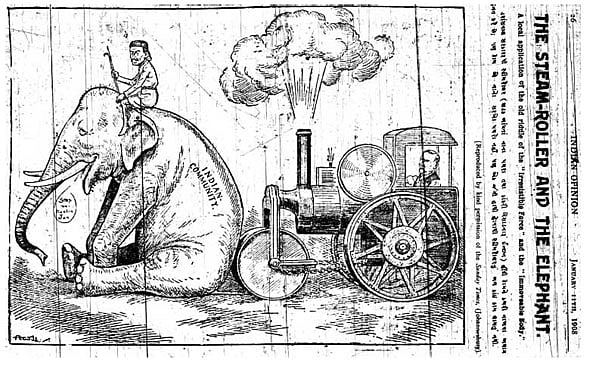
Ritu Gairola Khanduri's book Caricaturing Culture in India: Cartoons and History in the Modern World (2014) is a pioneering study of the rich and complex history and artistic concerns of the newspaper cartoon in India. Consistent among its multiple objectives – part history, part ethnography and part personal journey – is an attempt to map an alternative historiography of the nation by archiving cartoons. The author applies the terms 'tactile' and 'tactical' to refer to the humour and politics associated with cartooning. These terms describe a way of understanding lived experience. In the postcolonial world, Khanduri seems to imply, the universal structure of capital is only available as caricature. The author sees in this the potential for oppositionality, a reason that is visceral, where we are able to make use of all our senses. This allows everyone to become an expert critic.
There are two key questions regarding the role of humour and caricature in the Subcontinent, which Khanduri's book does not raise directly and yet forces us to ask: first, the question of labour or class relative to vernacular agency (derived from notions of a communitarian identity) and, second, the fate of difference or alterity in an age of global capitalism. The book assumes that the rich and diverse modalities of being in the Subcontinent cannot be explained through class analysis. Her important contribution to the study of Indian humour brings out key questions of difference and totality in understanding cultural and social opposition, helping to elucidate what is at stake in the debate between Marxist and postcolonial theories of culture.
Khanduri uses some unconventional sources to map the field. A large part of her archive is non-traditional and emerges out of her research process. Mohandas Karamchand Gandhi's extensive paraphrasing and translation of English cartoons for his South African Indian Opinion and Gujarati publications, and the vernacular press reports on the many Hindi Punch versions (regarded as a source of colonial anxiety for its 'insurgent'appropriation of the content of the British Punch), may be seen as the traditional, textual archive. The research was conducted over ten years, and the bulk of the sources emerge from wide-ranging interviews with cartoonists, fans and activists, gossip, and a discussion of cartoon controversies – a project impossible without the direct intervention of the ethnographer-author.
Khanduri presents herself as an interpreter rather than a translator. While translation implies the possibility of finding the same meaning in another language, interpretation leaves the field open to speculations since exact correspondences are not necessary. Self-reflexivity becomes a useful tool to navigate this untranslatable field, as one can say things without being held accountable to objective truth, while yet being able to gesture toward a shared cultural ethos. Khanduri seems to be both at home and not quite at home in this. For instance, she tells of how she brings packets of sweets to the homes of the people she interviews, showing herself to be actively complicit in representing their worldview, and creating bonds of familiarity and friendship. Such personal accounts, while seeming sometimes random, foreground her subjectivity, and are also calculated to show that things are always mediated by the unique codes and conventions of a culture. However, the fact of mediation is not without individual agency. Khanduri is keen to show that these mediated responses are a testimony to the enviable autonomy with which people approach life within a market. Mediation then becomes something akin to bargaining skills.