
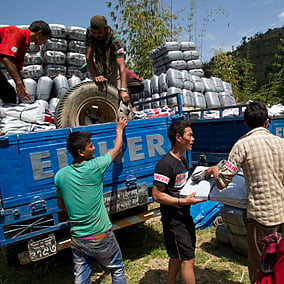
About 30 kilometres from the capital city of Kathmandu, Falame in Ryale Village Development Committee (VDC), Kavre, is a small village of about 90 houses. Located on a high hill, the community there has lost most of the houses, but there have been no injuries, and aid (mostly in the form of food supplies) has been coming in since the third day after the earthquake. All the aid in this Tamang village so far has been from private or non-governmental sources but routed through the local government office, and the frustration this has created in Falame demonstrates some of the complexities of aid delivery and coordination.
Faudi Tamang of Falame works at an LP-gas distribution centre in Kathmandu. On hearing about the devastation in the village, his employer offered to get in touch with Indreni Samaj, an NGO he was involved with, and send relief through the organisation. The village did receive sacks of rice and dal, and some tarps. But the aid package was smaller than what Faudi was promised, and the quantities, especially the five tarps they received, were wholly inadequate for the village which has lost most of its 90 houses.
"I heard we were sent 90 sacks of rice but Sambhu Adhikari [VDC Secretary] sent it to his own village in Bhumedanda. It's not even the same VDC," Indra Bahadur Tamang added with casual cynicism, "He is from Bhumedanda, you see." His uncle Aaite Tamang joined us. "A delegation of about 50 people went to the VDC office," he told me. "But the secretary is never clear. Sometimes he tells he sent the aid to us, sometimes to the others. We will be sending a letter to the VDC, asking for more relief."
The disappointment of the villagers and the potential for cynicism is an understandable result of the complex process of aid distribution. The government has asked that relief be routed in coordination with local government houses, so that it can reach the neediest, and in the case of Falame the VDC felt there were others who had an equal, if not more urgent claim on the resources.