
With an intra-regional trade of only 5 percent, Southasia remains one of the least economically integrated regions. The reason for this is simple: despite the formalisation of treaties like the agreement on South Asian Free Trade Area (SAFTA), Southasia is not really an economic union. Even with SAFTA, free trade of goods is severely restricted as the region's largest economy, India, still retains a significant number of items – over 600 – on its 'sensitive list' for which tariff reductions do not apply.
At present, when governments in the region are actively pursuing investments from around the world, a greater push for SAFTA is not surprising. While the leaders of the region did note how a better integrated Southasia would require greater movement of capital and people across borders, they said more about removing trade barriers than, say, relaxing visa regimes.
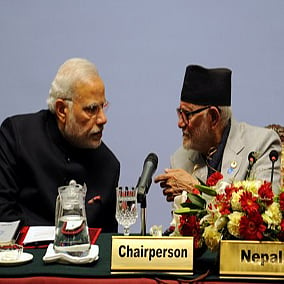
Predictably, Indian Prime Minister Narendra Modi's inaugural speech of the SAARC summit posited India as the primary entity around which the region should organise itself. His focus, by and large, pivoted on investment and infrastructure, much like the platform on which he won the general elections in India. As Modi put it, "We speak of ease of doing business in India. Let's extend this to our region. I promise to ensure that our facilities at the border will speed up, not slow down, trade. Let's all make our procedures simple, our facilities better, our standards common and our paper work less burdensome. India will now give business visas for three to five years for SAARC. Let's make it even easier for our businesses through a SAARC Business Traveller Card. Excellencies, India has a huge trade surplus with SAARC countries."
Clearly, Modi intends to take his 'Gujarat development model' to the region. It is worth pausing to consider what this means. Everywhere he sees "the rising tide of integration", this simply refers to the breaking of barriers to facilitate free trade, attract Indian investment in the region and allow room for unfettered business transactions. Along these lines, Modi spoke of deepening links between Bangladesh and India by agreements through "rail, road, power and transit". This involves Bangladesh giving parts of its land as Special Economic Zones (SEZs) to India.