
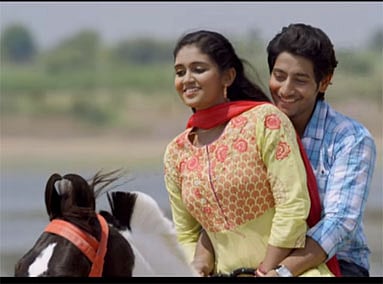
At a time when caste consciousness is seeing an unprecedented resurgence, Director Nagraj Manjule's Sairat uses the typical narrative framework of 'star-crossed lovers' to deconstruct the inhumanity of caste and the misogyny that prompts 'honour' killings. Yet amidst all the acknowledgement of the film's take on caste and gender and praise for the way Sairat depicts it, there are some questions about these representations that emerge.
But first, a story I heard while discussing the status of Maratha women within their community: A few years ago, a journalist had called up a Maratha politician, whose wife had been elected as the Zilla Parishad Adhyaksh, to get her photograph for his newspaper. The man replied: "Ab kya hamari auraton ka photo paper me aana baki reh gaya hai?"(Is this what it has come to now? Our women's photos coming out in the paper really is the last straw.) It is said that this woman was represented by her husband everywhere and never allowed to venture out in public – not even for the election campaign. In newspapers, when the photographs of various politicians were printed, there was always a blank box in place of her face, with just her name underneath it – a clear indication of the oppressed status of women within orthodox Hindu communities.
If we go back into history to look at anti-caste struggles, we will come across Tarabai Shinde. A radical figure, who wrote the provocative essay titled 'Stri Purush Tulana' that compared men and women in a colonial society. Her essay was the target of much vitriol from members of her caste and community. In the end, it was Jyotiba Phule, an Indian activist, social reformer and writer, who publicly wrote in her defence in 1885, supporting Tarabai Shinde's stance and analysis. Apart from this phenomenal essay, there is little else that is known about her. Her essay remains her only historical legacy.
These two stories set the context of what the movie deals with – the fact that Maratha women are mostly prevented from actively participating in the public sphere. The upper-caste Marathas forms one-third of the total population of Maharashtra and they have been politically and socially dominant. The community continues to be steeped in feudal relations and values. To repeat an oft-stated fact, the nature of the oppression and the manifestation of the upper-caste Hindu self is deeply interlinked with the oppression of women. And so, even though a Maratha woman may wield power over both men and women from 'lower' castes, she continues to be oppressed within her own community. 'Maratha-ness' is not possible without these unequal gender roles and power relations, manifesting as control over the sexuality and mobility of women. Keeping their families' 'honour' intact is the primary responsibility of the women from this dominant caste.