
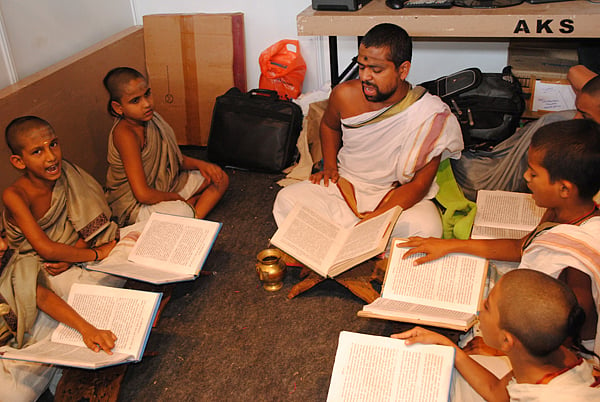
Out in northeast Delhi, nestled amidst the industrial, agricultural, and residential suburb of Mandoli, is a small compound where a committed group of Sanskrit enthusiasts live, study, teach and speak only Sanskrit. Camps are held there year round, run by Samskrita Bharati, an organisation devoted entirely to propagating spoken Sanskrit "in every home and in every village" (grihe grihe graame graame). This motivating ideological force extends to "every city in every nation" as well (nagare nagare deshe deshe).
Samskrita Bharati is a part of the Sangh Parivar, the collection of nationalist, political, social, paramilitary, religious and cultural organisations devoted to the furthering of its particular version of 'patriotic' Hinduism. The Sangh would like to see an ideal utopian Hindu nation and world with Sanskrit as its lingua franca. Samskrita Bharati's role in this movement is linguistic and cultural; however, it is enmeshed in the political, religious, and para-military preoccupations of the Bharatiya Janata Party (BJP), Vishwa Hindu Parishad (VHP), and the Rashtriya Swayamsevak Sangh (RSS), respectively. Sanskrit is a symbolic vehicle for the ideology and practices of the Sangh Parivar. Samskrita Bharati's mandate is to undertake the "Revival of Samskrit as a mass communication language (jaanabhaashaa) and facilitation of common man's access to its vast knowledge treasure."
I first attended Samskrita Bharati's residential spoken-Sanskrit camp near Nand Nagari (the city of bliss) in Delhi for a month in 2009. The samvadshaala, as the camp is known, means the 'hall where people converse'. This particular camp runs throughout the year, except between February and April. Samskrita Bharati operates in 19 countries including the US, Germany and Australia, facilitating similar Sanskrit camps to those in India. However, the Mandoli camp is the operation's flagship course. The other camps run less frequently, or for shorter periods.
I returned in late 2013 to revive my own spoken Sanskrit and to take a closer look at the camp, what they teach and why, and the types of students motivated to attend these camps. Having attended the camp three times in total, my spoken Sanskrit is much better for this intensive instruction. I can understand spoken Sanskrit reasonably well, and can hold a conversation, though grammatical errors still creep in.