
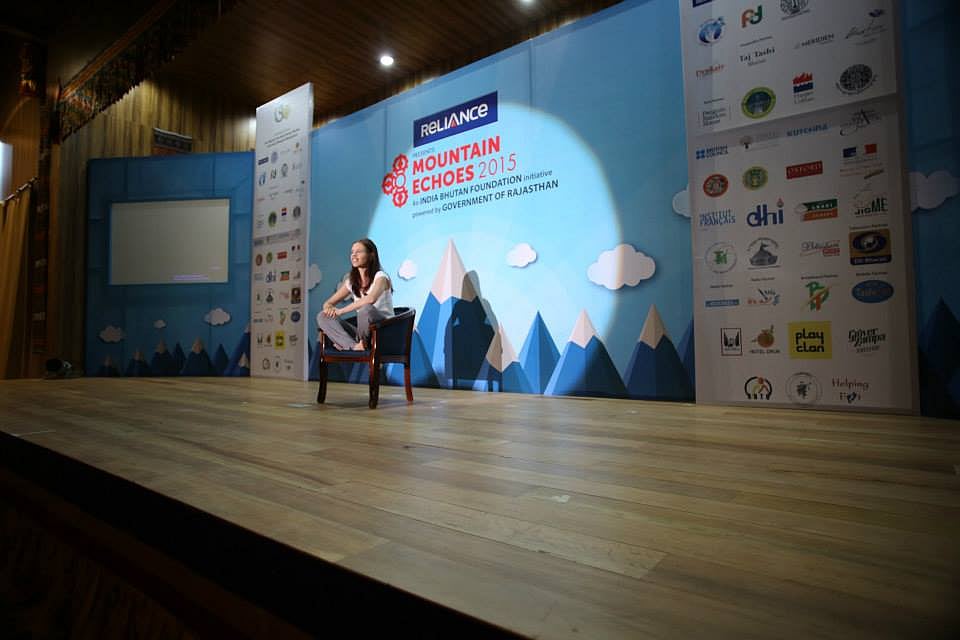
On a grey day last August, the sixth edition of the Mountain Echoes literary festival got underway in Thimphu, with all of the exotic promise of a tourist brochure. Dancers from the Royal Academy of Performing Arts spun and twisted through the drizzle, and the Queen Mother, Ashi Dorji Wangmo Wangchuck, accompanied by very little security, walked among the traditionally-attired crowd. Two masked jesters skirted the dancers and lunged comically at the audience, unsheathing formidable wooden phalluses from their pockets and thrusting them under people's noses, to confront and dispel the illusion of embarrassment.
The auditorium of the Royal University of Bhutan was packed, the adults in seated rows and the stairs filled with cross-legged teenagers, some with their notebooks out and ready for the opening lecture on Emperor Asoka. Vasundhara Raje, the Chief Minister of Rajasthan, was second on the bill, but was summoned away on urgent government business. In stepped a blonde scholar from England, clad in the traditional Bhutanese gho, who recited a poem about becoming a Buddhist, and dedicated it to the Queen Mother. The rest of the morning was taken up by a photo exhibition on the journey of the 7th century Buddhist pilgrim and scholar Xuanzang and a passionate discussion on food by Rocky Singh and Mayur Sharma, hosts of the popular NDTV show Highway on My Plate. In the afternoon Patrick French and historian Nayanjot Lahiri bantered about the relative morality of Asoka and V. S. Naipaul. A puppet show ended the first day, and the organisers – looking relieved – set about securing more chairs. The audience ambled out into the cool evening air and back down the hill into town for cheese and chilli.
Last year's Mountain Echoes was the festival's biggest instalment yet, and coincided with Bhutan's National Reading Year. Gushing reports from the Kuensel newspaper tell of readathons out in the districts, and of single schools having read thousands of books. Since the 1980s, the Bhutan story has been dominated by the concept of Gross National Happiness, a term coined (so the legend goes) by the Fourth King during an interview with a Financial Times journalist. The idea of an indicator that measures happiness rather than economic production per capita put Bhutan in a unique place on the development map, and GNH has been consistently promoted and pedalled on the world stage by its government ever since. It now permeates – or at least prefaces – almost all literary writing from and about Bhutan, too.
The majority of this writing consists of travelogue-memoirs by world-weary foreigners, on a quest to see if Bhutan's Shangri-La idyll still remains, and whether it can offer anything for their own society's pursuit of happiness. Even after twenty-odd years, the spirituality-versus-materialism clichés are stuck in the same rut: amateur grapplings with Buddhist ideas of impermanence can still be relied upon to fill pages, and the fact that there are no traffic lights in the capital Thimphu is continually remarked upon. Radio Shangri-La, Married to Bhutan, The Kingdom at the Centre of the World and A Field Guide to Happiness are some recent releases guilty – to varying extents – of perpetuating this stale narrative. The genre itself is more interesting nowadays for the fact that women writers are at least as well represented as men, than for anything new it has to say. "Whether you like it or not, we are beginning to shed the last remnant of the so called Last Shangri-la," wrote filmmaker Tashi Gyeltshen in Business Bhutan, a few days before the festival began. "We are way out of our self-imposed 'splendid isolation'… GNH as a political philosophy is yet to intellectually mature and developmentally prove. In the meantime, a new set of population with a new set of morals is starting to replace the old."