
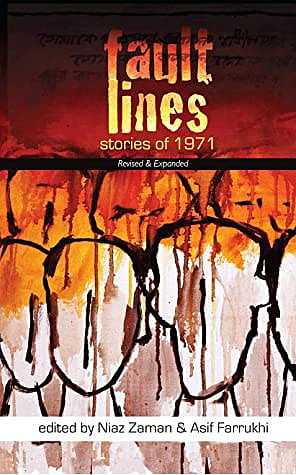
As the first anthology on the 1971 War of Liberation to bring together voices from India, Bangladesh, Pakistan, the US and the UK, Fault Lines is much more than a mere collection of stories. Rather, the 37 works of fiction in this compilation provide an extensive look into the human drama that was unfolding against the turbulent, violence-ridden backdrop of 1971. While most of these pieces, with the exception of six stories originally written in English, were penned in Urdu, Bangla, Punjabi and Sindhi, the translations are notably smooth. This allows for an important process of comparison and differentiation between these accounts, nearly four decades after the experience itself.
Almost as interesting as the stories included in Fault Lines is the introduction that precedes them. Editors Asif Farrukhi and Niaz Zaman – a Karachi writer and an English professor at the University of Dhaka, respectively – get the volume going by providing some unique accounts of their own memories and understandings of that critical time. Both recognise that 1971 did not – and, importantly, cannot – have the same meaning for Bangladeshis as it did and does for (West) Pakistanis, just as its reality cannot be reconciled into a single neatly packaged account. Without being confrontational, the editors' voices are personal, candid, conversational and direct, and the intimate tone of their introduction shows a comfort with deciding neither to embellish nor compromise their personal encounters with history for the sake of political correctness.
Particularly refreshing is how Zaman, far from dealing purely in abstractions and intellectualisms, ends her account with a look at the current political scenario in Bangladesh. In so doing, she speaks of the country's inability to put into practice the ideals for which the War of Liberation was fought. The fiction that follows in this collection is likewise stripped of the propaganda and politicising of history, something that is so rampant throughout many parts of the world. In this respect, Fault Lines takes a much-needed step towards fostering mutual understanding, acceptance and acknowledgement of a shared, albeit difficult, history.
The stories in Fault Lines are all remarkably in sync with one another. This is so not only thematically, which they are of course intended to be, but also in terms of their style and tone, flowing smoothly from the realistic to the surreal, from the graphic to the dream-like. "The Sin of Innocence", for instance, is a straightforward tale of families caught between two opposing militaries, forced to make life-altering decisions when arbitrary identities and loyalties are forced upon them. On the other hand, "Versions of Truth", like many of the other stories in this collection, particularly those translated from Urdu, has a fable-like quality to it, where metaphysical and even magical situations represent an alternate reality that is even more troubling than what is happening all around.