
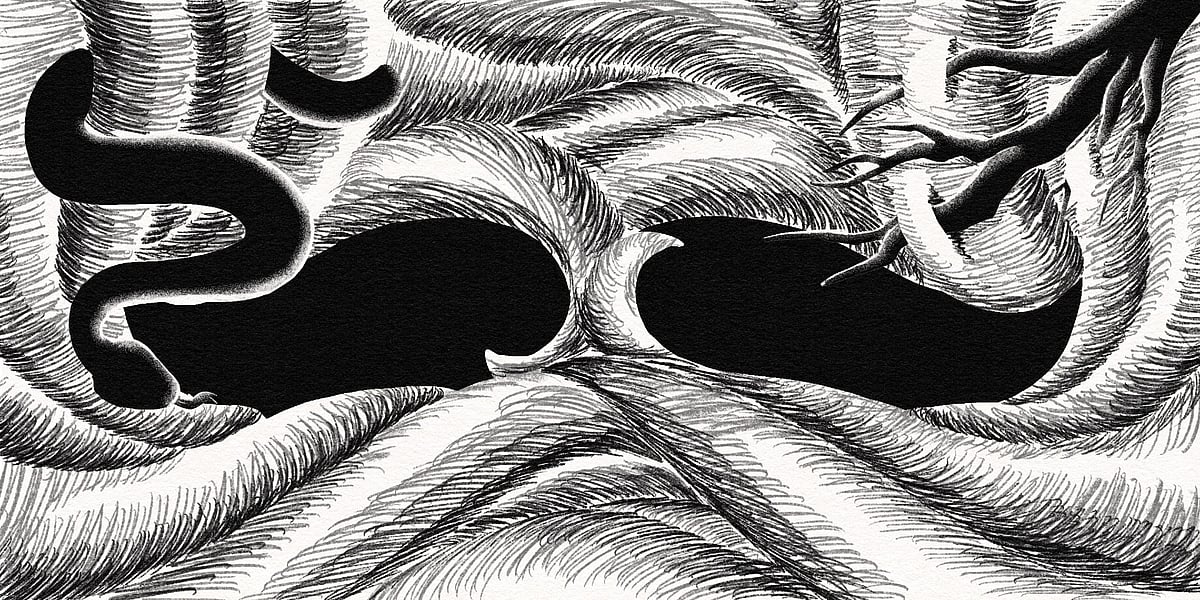
What has to happen to the world for the animals to start talking? In S Hareesh's novel Moustache, a whole menagerie has something to say. Crocodiles seek revenge for old trauma, bullfrogs dispense free advice, and coconut trees speak of generational memories. Kuttanad, the landscape that is the novel's chief allegorical tool, swallows and spits out people and stories. By the novel's end, the reader heaves a heavy sigh, for the world has been distilled to a single story – of each of us trying to live as best as one can, while caught in the intersections of caste, class and community.
Moustache, titled Meesha in the original Malayalam and translated into English by Jayasree Kalathil, follows a long literary tradition in the language and is best described as magic realism. Around the same years that Gabriel Garcia Marquez was working on his magnum opus, One Hundred Years of Solitude in Colombia, a book that continues to define the genre, in Kerala, O V Vijayan was writing his masterpiece, Khasakinte Ithihasam (The Legends of Khasak). Vijayan's debut novel might not have drawn international attention, but it inaugurated a new phase in Malayalam literature that was influential enough for some critics to divide the language's literary history into pre- and post-Khasak. As a genre, magic realism remains popular in Malayalam culture, not just in literary works, but also in cinematic forms. Marquez and other Latin American writers were translated into Malayalam well before they were available in other Southasian languages. Thanks to the abundance of reading rooms and libraries in Kerala, these books were easily found even in small villages.
However, it would not be correct to say that this access was what led to Malayalam's adoption of the genre. The expression of inner experiences without resorting to the continuous and linear narrative is a storytelling tradition long practiced in most cultures, Southasia and Marquez's Colombia included. The oral tradition of rich folklore culture across the Subcontinent, and even more Brahminical works from mythology, the epics and allegorical works like Panchatantra, employ narrative styles that formally resemble magic realism. Hareesh's Moustache, translated into English by Kalathil, is a notable addition to these storytelling traditions.
Vavachan, the novel's protagonist, is a Pulayan, from a Dalit caste in southern India. He is recruited to play a policeman in a play directed by a travelling playwright and director, solely based on his thick moustache that has somehow escaped the barber's blade. This also gives him the name 'Moustache'. When he appears on stage, the facial hair on his dark skin looks fearsome enough to terrify the audience. He reminds the audience of the mythical demon king Ravanan, though his role is otherwise inconsequential in the play. After the theatre group packs up and leaves, Vavachan refuses to shave off his moustache, triggering a period of turmoil, violence and fear in the Kuttanad region where the story is set.