
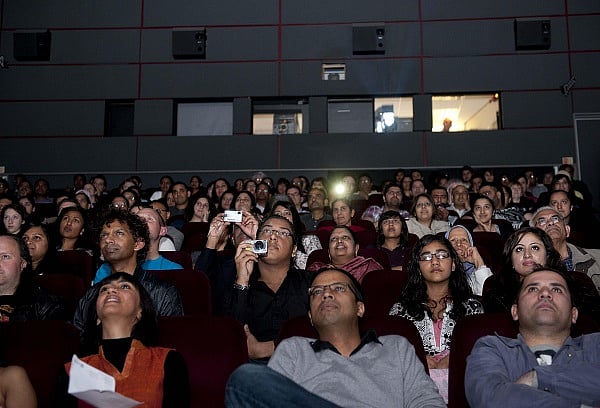
One of my earliest memories of watching films has less to do with the film itself and more with the anticipation of the moment when the film was to begin: when the red velvet curtains rose inch by inch and disappeared into some mysterious space above the screen; the moment when the lights dimmed and people hurried to their seats by the light of the usher's torch; when the projector began its whirr and threw a beam of mote-filled light over our heads. It was a magical anticipation, as dream-like and associative as cinema itself.
The theatres were large but the audience felt close, as if we knew each other even though we'd never met, as if we could make assumptions about each other like friends can, all because we shared for the duration of the film the womb that was the theatre.
For a long time this was the way I watched films: the late night show with my parents, the popcorn or chutney sandwiches at Sangeet Theatre in Secunderabad (or even better, 'rolls' stuck on each finger of one hand) and finally, the ride back , nearly asleep on the backseat and watching the moon follow me home.
It wasn't until I was eight or so that I had my first experience of watching a film in a setting other than a classical film theatre. My grandparents stayed in a small town called Mettur, and every Saturday there was a film screening in their neighbourhood. Sometime in the late afternoon a screen would be set up in a clearing and a table and projector would appear, but oddly enough there were no chairs, or apparent seating arrangements. Come dusk and first the children would gather, followed by the adults. They came as if for a picnic, with rugs, pillows, even blankets, certainly chairs – both the solid ones that needed two people to carry them and the foldable ones we called 'easy' chairs. Clearly, the people of Mettur came prepared to enjoy both the film and a light snooze.