
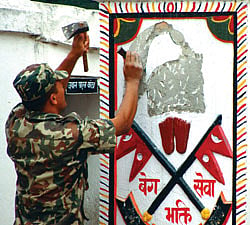
Since 28 May 2008, when the Federal Democratic Republic of Nepal was born, a kingdom has begun to disappear in earnest. The departure of the ex-king and queen from the Narayanhiti Palace two weeks later marked the beginning of the end of what will be a long process of erasure and (if we dare use the word) disappearances, which are sure to be fraught with unexpected complications and surprising results. Thus far, these erasures have taken various forms. A picture of a mountain is printed over the royal visage on Nepal's 1000-rupee note, where a watermark shadow of the same face still lies hidden under a rhododendron bush. The sripech crown has been scraped away from the gate of the palace's cavalry quarters, leaving behind its shadow, along with pairs of feet and flags. A newly coined national anthem makes no reference to an element long seen as key to sustaining national sovereignty. Even Nepal's flag-carrier airline has ceased being Royal.
These are all rather trivial examples of the erasures that one would expect. Others, however, are more complex. An ostensibly royal Daimler Benz, gifted by Adolf Hitler, is said to have been the victim of an attempted ex-royal theft, only to have been revealed as having never been royal at all, but rather a set of Rana wheels, presently in India. This is a complex double disappearance; what the new nation imagines to be a part of its historical legacy – albeit a problematic one, in this instance – turns out not to have been the object of illegitimate ex-royal avarice, but in fact the rightful inheritance of Janak Rajya Laxmi Devi Shah, daughter of Juddha Shamsher Rana, and left behind in India with her brother because it had never been registered in Nepal. So, with a false accusation and subsequent inquiry comes the revelation that there is one less item for the newly announced Narayanhiti Palace Museum, which is apparently wanting for a collection worthy of unveiling to the public. In this instance, ex-royals are accused of trying to steal something that was not even there to be stolen.
This may be part of a larger pattern of republican citizens being robbed of what they never had. For instance, that the royal family might not be living a life of luxury in a fabulously appointed palace first became widely apparent with the detailed revelations about their quarters that arose from reports on the royal palace massacre of 1 June 2001. The stark modesty of the former royal family's new accommodations in the Nagarjun forest, on the outskirts of the Kathmandu Valley, has further lent credence to the possibility that, as far as palatial sumptuousness is concerned, there might well have never been any there there. This writer, like many others, had always been under the impression that, within the mysterious walls of Narayanhiti, fabulous fortunes were to be found.
Citizens of the new republic may now have to confront the possibility that their king had not actually been the obscenely affluent kind of autocrat in whom subjects (and even ex-subjects) might take a certain kind of perverse pride. After all, if people have been subject to royal exploitation for a couple of centuries or so, there ought to be at least the compensation of having some good loot to show for it, if only to illustrate the venality of their former rulers. But that which was never theirs as royal subjects may have never been there at all – and thus offer nothing for republican citizens to claim as either evidence of royal greed or as national treasure.