
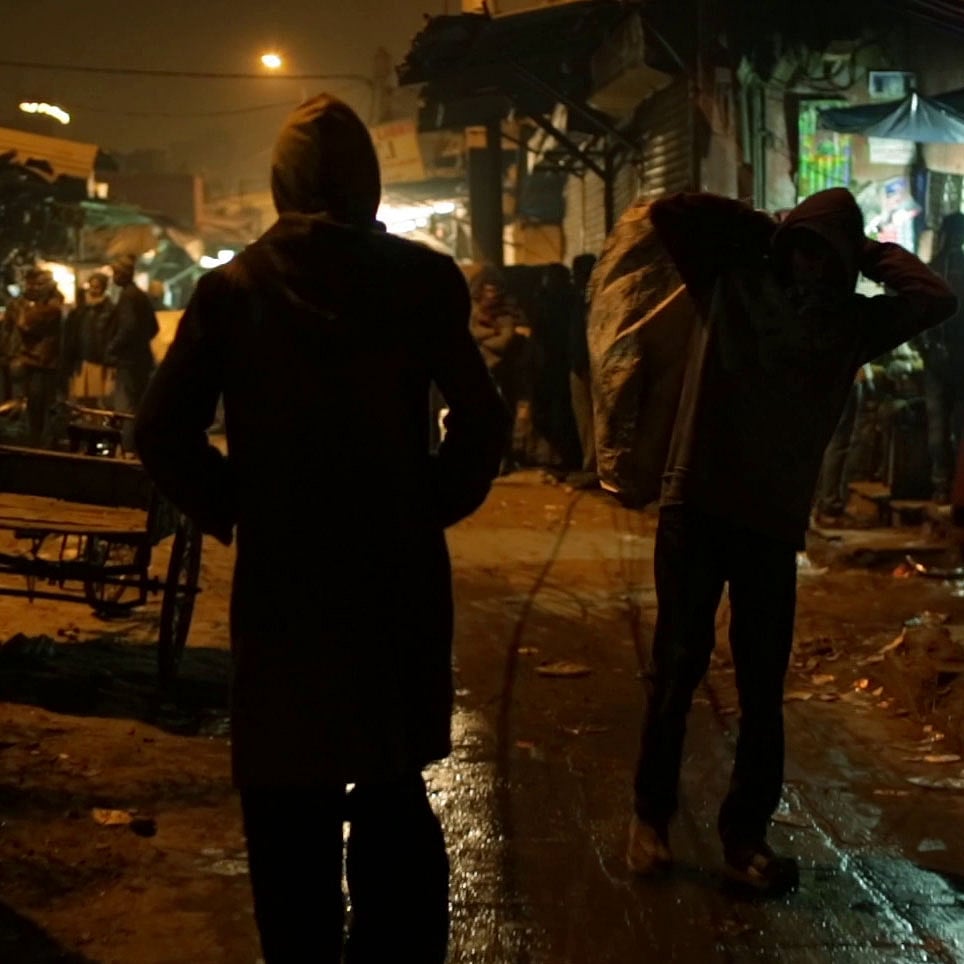
If it is human to want a proper place for sleeping, to be deprived of such a place must mean becoming less than human. Indeed, we are 'conditioned' to sleep in a familiar and known space. This underscores what it means to be a person. But when someone is unable to find a place to sleep, the line that separates the human from the animal becomes nebulous. This realisation haunted me after watching Shaunak Sen's documentary film, Cities of Sleep. It is a superbly imagined and crafted film on what afflicts the poor in some of the most neglected corners of New Delhi's urban landscape. The night lives of the city's homeless are brought into focus as their liminal existence and choices are explored as unobtrusively as possible. The subtle background score lends a melancholic touch that goes well with the film's disturbing themes and the uncomfortable questions it poses.
Ranjeet, a caretaker at a sleep shelter, philosophises in the film, "It's not just about the dearth of money. Poverty means you can't become fully human." This statement goes to the heart of the problem. When you are poor, you have less of everything that comprises the idea of life. Cities of Sleep shows us the world of sleep shelters, where the human and the animal can enter each other's territory and blur the distinctions between the two. There is a telling scene in the film where a dog is discovered sleeping in one of the shelters on a wintry night. But the caretaker kicks the dog out saying, "the place is not meant for dogs". The sleep shelter claims its 'human' territory and excludes the animal. The dog is an uncomfortable presence for the caretaker, perhaps because its state resembles the state of the people sleeping there. Once the dog is kicked out, through an act of control and power, the space is reclaimed for humans. It is a similar act of control that often keeps other people, who don't meet the shelter's standards for admittance, out in the cold as well. The same attitude allows the law, and the policemen enforcing it, to banish human beings into the animalised corners of the city.
The most intriguing character in the film is Manoj, alias Shakeel. Gufran bhai, the caretaker of a children's night-shelter, describes Shakeel as lazy and a habitual liar. In the film, we see Shakeel fake being lame while begging at a red light. We hear him say, in the voice-over, "when you are utterly poor, you feel oddly relieved; at peace even. You have fallen as low as you possibly could. Things can't get worse, and it is okay." Shakeel's interpretation of his situation, if read alongside the film's images, leads the viewer to infer that being utterly poor also allows him to be who he is, or rather, who he is not. Looking poor does not render him pitiable enough within the economy of beggary. So he prefers to invent a handicap, his body mimicking the movements of the lame, to evoke sympathy from prospective alms-givers at the red light. There is no obvious moral quandary; it's a pragmatic choice that helps him buy his meal, and a place to sleep at night.
Shakeel, we come to know later, changed his name, simply to fit into the larger Muslim community in the sleep shelters of Meena Bazar. He prayed in the mosque to validate this new social identity. It will be simplistic to judge Shakeel's actions in terms of what is real and what is fake. Just as the material condition of poverty throws Shakeel into realms considered less than 'human', his circumstances require him to stray from his 'authentic' cultural self. So he plays at being Muslim, to better fit his cultural habitat. His decision raises questions about whether economic and cultural safety – which allows the performing of an 'authentic' expression of cultural and religious identity – is a privilege open to only those who are relatively well-off. Shakeel performs a superimposed religious identity, both publicly and privately, erasing all stable distinctions between these two spheres of existence. We don't know what Shakeel believes in or what his faith is, except for his decision to live as a Muslim in New Delhi. He does not lose sleep over who he is. Authenticity is not a question of 'being himself' for Shakeel, but 'being in the world', of surviving it. To fake authenticity is his game. In Shakeel's world, or his version of the city, he gains entry more easily by playing what he is not. While the city denies him his identity, Shakeel opts to create many invented identities. Lying allows him to travel at ease, and find a place in a world that denies him even a proper space to sleep.