
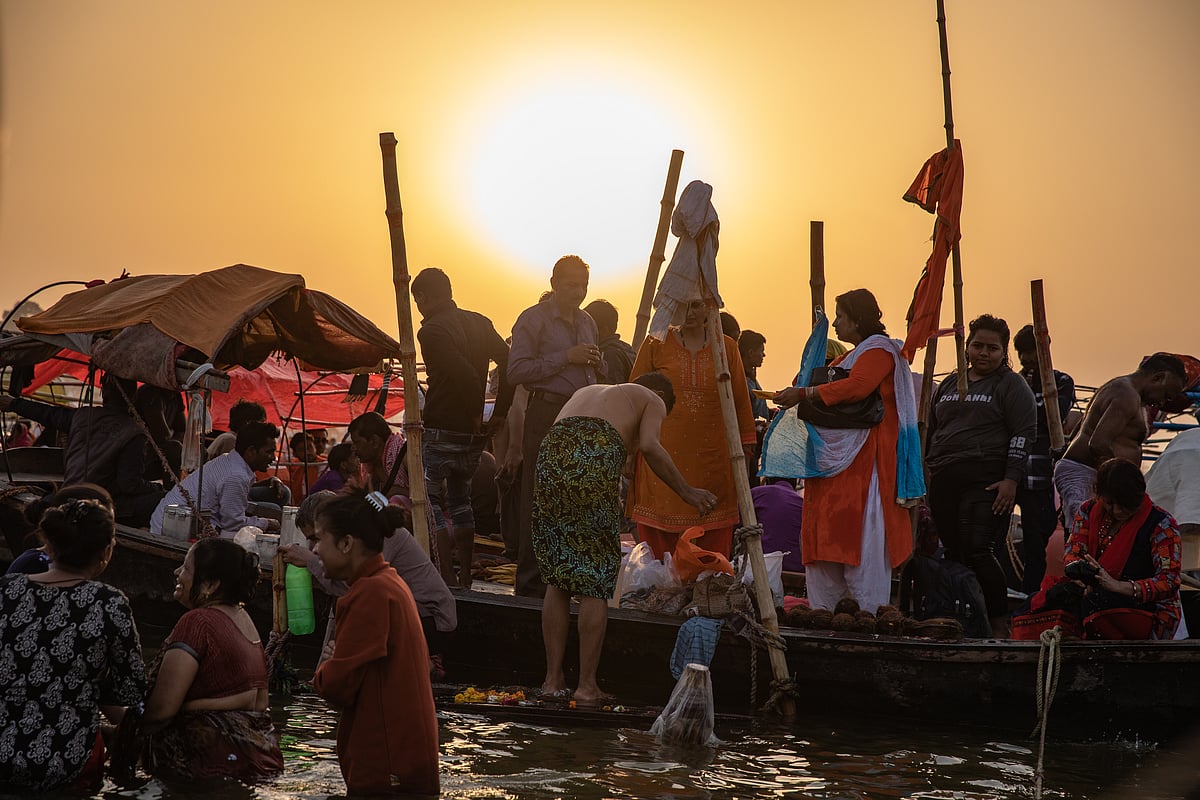
The Kumbh Mela of 1954, intended to be a celebration of the new India, became the greatest single day of death since the partition of 1947. On the main bathing day of 3 February, a crowd vastly greater than expected, estimated at between two and four million people, moved towards the confluence of the Ganga and Jamuna (the sangam) to bathe. When processions of holy men, demanding privileged right of way, became entangled with the crowds, frightened pilgrims ran, tripped, fell and tumbled down embankments made muddy with winter rain. Officially, 14 children, 49 men and 253 women were killed and thousands injured. Though the Prime Minister and other "VIPs" watched from the ramparts of Allahabad's famous Fort, the size of the crowd was so great that the stampede was not evident and they did not learn of it until late in the afternoon. This was a stark metaphor for the new India: the rulers standing on the walls of an ancient fortress able to see the people, yet unaware that the people were surging to their deaths.
In the aftermath, one of the accusations was that politicians and officials had sought a record-breaking Kumbh Mela crowd to demonstrate the vitality of the new India. The chairman of the inquiry denied the allegation. "Hundreds of thousands of people have been coming to Prayaga to bathe in the Sangam for thousands of years from all over India", he wrote. Their "irresistible inner urge and undying faith" meant that "no propaganda is needed to induce such people to come". And in this year, "the news … spread and reached every corner of the country" that "this year's Kumbh was of extraordinary significance", a particularly auspicious occasion, happening only once every 144 years".
The Mela in 1954 united two different impulses: the "irresistible inner urge" of ordinary Hindus and the visions and ambitions of the men and women trying to remake the Indian state. Even the author of the inquiry report conceded that the way in which the Kumbh Mela elicited a common do-or-die spirit in so many people in so many parts of India represented "a valuable asset in the national character of a people," because it did not need government incitement.
There was little doubt that government and leaders sought to make the Kumbh Mela a great event. The railways promoted their special trains to the festival, and officials in charge of arrangements were said to have been "animated by the feeling that the 1954 Mela, being the first big Kumbha at Prayaga after independence … should be made a grand success". The Planning Commission took the opportunity to bring "home to millions of people" the virtues of the First Five-Year Plan "through Charts, Models, Maps, Radio Talks and Film Shows" at the Mela. And leading politicians and their associates made well-publicised plans to attend.