
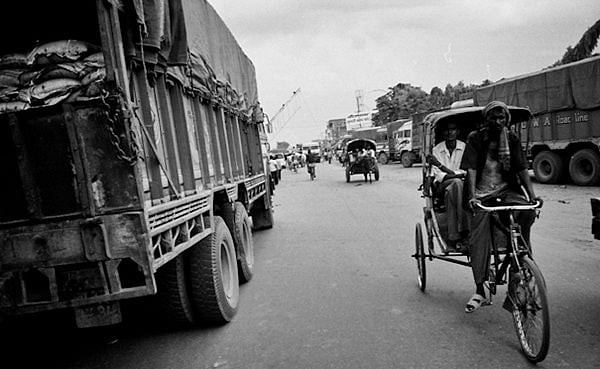
The night bus had arrived early at Birgunj, on the Nepal side of the Indo-Nepal border, a rare occurrence that I was not able to appreciate fully because it was 4:30 in the morning, and the city was still slumbering. Trying to figure out what to do with myself, I turned to Bikas, a friend I had just made on the bus journey. "Which way is the border?" I asked. "About 15 minutes down that way," he replied, pointing down a deserted road that dissolved into darkness. "Would you like to see it?"
We found a rickshaw heading toward the border and set out south. As we rode, the early morning began to crack through the night. Along the road, open fields dotted with unremarkable cement buildings slowly came into view in the pinkish light. A tonga carrying a few passengers passed our rickshaw, and Bikas flagged it down. "How about some tea?" he asked as we climbed aboard. A few minutes down the road, Bikas pointed to a wooden archway: "That's the gateway of Nepal." Confused, I asked where we were going. "To India," he responded, "to drink tea."
Our tonga was no longer in Nepal, but it was also not yet in India. We were passing through a no-man's land, a hazy patch of earth that does not officially belong to either country. The sprawling Gangetic plain extended outward on either side of us, and it was not clear where one country ended and the other began. On the far side, an Indian border official stopped our cart. The other passengers in the cart were either Indian or Nepali and, unlike me, did not require a passport for the crossing. Bikas explained that he and I were heading to India just briefly, to drink some tea, and the official waved the tonga on. And just like that, we had arrived in Raxaul, Bihar. We drank our tea, and then crossed back into Nepal.
This porousness and lackadaisical attitude thrives all along the Indo-Nepal border, and is of considerable anxiety to both the Nepali and Indian government. Since an open border was created under the Indo-Nepal Treaty of Peace and Friendship of 1950, this frontier has become one of the world's major smuggling hubs, due both to its length and to its strategic location as a crossroads between West Asia, China, Southasia and Southeast Asia. Gold, guns, watches, electronics, tractors, cars, mechanical parts, rice, sugar, fertiliser, ready-made clothes, liquor, drugs, perfume, iron and much else is smuggled across easily and frequently. Although official statistics are not available, a study conducted by the Federation of Nepal Chamber of Commerce and Industries estimates that illicit commerce along the southern border alone totals nearly 40 percent of the country's foreign trade.