
This week at Himal
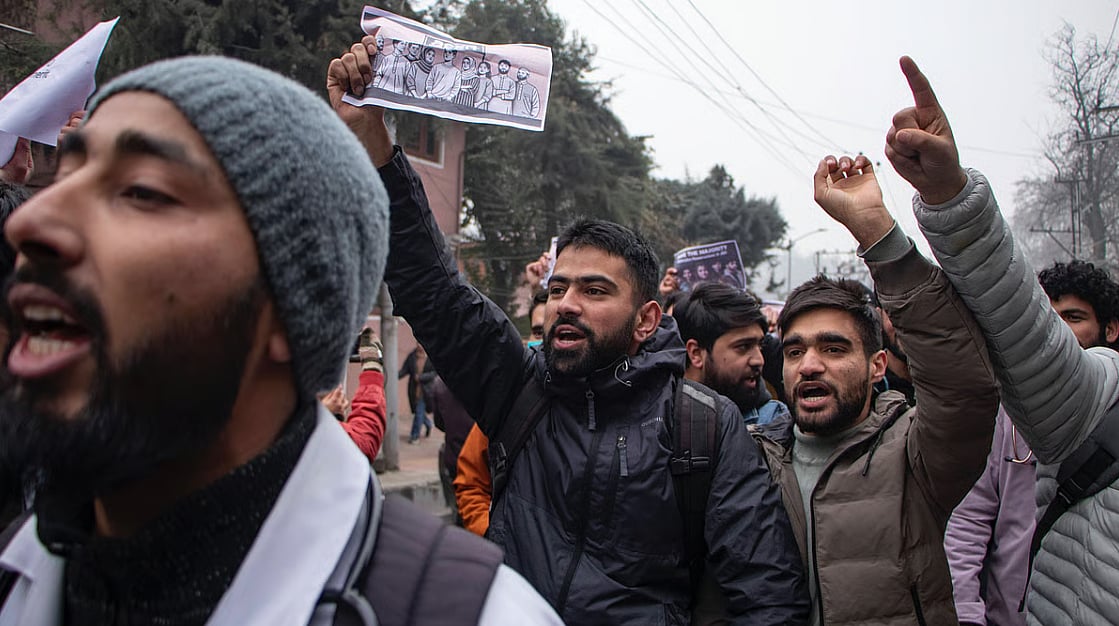
This week, Burhan Majid writes about how India’s BJP government has weaponised reservations to disempower residents of Kashmir, leaving the union territory’s elected administration in a tricky spot.
Don’t miss episode 3 of our podcast series ‘Partitions of the Heart: Conversations with Harsh Mander’, in which development economist Amirullah Khan talks about the deprivation of the majority of India’s Muslims, especially in education and employment.
For the next episode of the State of Southasia podcast, host Nayantara Narayanan speaks with French political scientist Christophe Jaffrelot about the dark legacies of emergency rule imposed by former Indian prime minister Indira Gandhi and its ongoing impact on contemporary politics.
Our Fiction Fest panel event on Caste, Gender and Resistance in Southasian speculative fiction is now online for those of you who missed it! And don’t forget to read the last few stories from Fiction Fest.
Also read: The Patch: Himal Fiction Fest 2025
Also read: Muslim Life – and Death – in Modi’s India: A podcast with Harsh Mander
Also read: The Water Diviner: Himal Fiction Fest 2025
Also read: Jerry Pinto on inclusive storytelling: Southasia Review of Books podcast #26
Also read: Ode to Abundance: Himal Fiction Fest 2025
Also read: India’s BJP government has weaponised reservations to disempower Kashmiris
This week in Southasia
Southasia braces as Israel-Iran conflict escalates
The rapidly escalating Israel-Iran conflict has directly impacted Southasia, with refugees and migrant workers caught in the middle. Afghan refugees residing in Iran are facing heightened economic and psychological stress due to Israel’s attacks, even as they face the threat of forced deportation from the country. The Afghan Ministry of Refugees and Repatriation has advised its citizens to avoid sensitive military and political sites. Meanwhile, Sri Lanka has temporarily suspended sending workers to Israel due to the precarious security situation, with Israel's international airports operating at reduced capacity. Four Sri Lankans in Iran have been injured so far. India evacuated 110 students, 94 of them from Jammu and Kashmir, who returned to Delhi via Armenia on 19 June. Around 45 Pakistani students in Iran also returned home, with 500 pilgrims returning via the Taftan border crossing.
Many countries in the region are having to recalibrate geopolitical relations. Pakistan has voiced support for Tehran but remains concerned about Baloch secessionist groups living in Iran’s border areas, who might cross into Pakistan as the fighting escalates, and the possibility of Israel encroaching into Iran’s airspace, close to the Pakistan border. India distanced itself from the Shanghai Cooperation Organisation's condemnation of Israel’s attacks on Iran, a stance attributed to its dual need to maintain robust defense ties with Israel, being its largest weapons buyer, while simultaneously fostering economic links with Iran in order to maintain trade access to Central Asia and Afghanistan. A day before, India abstained from voting on a UN draft resolution calling for a ceasefire in Gaza - the only Southasian country to do so. Escalation could severely disrupt regional trade routes, impact energy security, and potentially destabilise the already volatile geopolitical landscape in Southasia, even as Southasians risk being caught in the crossfire.
From March 2025, Harsh Mander’s article flagging the Narendra Modi regime’s support of Israel’s genocidal war as a moral and political transgression is worth re-reading in light of the current headlines.
From the archive (March 2025)
Also read: The Gaza apocalypse and India’s guilt
Elsewhere in Southasia
- India and Canada to return ambassadors as Canadian prime minister Mark Carney seeks to restore diplomatic relations with India at G7 Summit amidst Sikh protests in Canada
- Pakistan army chief Field Marshal Asim Munir receives warm welcome in Washington, indicating a reset in Pakistan-US relations, to India's concern
- UN Working Group on Enforced Disappearances delegation arrives in Bangladesh after requesting a visit for more than a decade, to meet families of the disappeared, disappearances commission and law enforcement agencies during their visit
- India illegally deporting Muslim citizens at gunpoint to Bangladesh, say rights groups; about 200 Indian citizens returned to India
- Rare footage of former State Counsellor of Myanmar Aung San Suu Kyi in court and new details of prison routine released, as family and supporters raise health concerns before her 80th birthday
- Presidential commission in Maldives rules out foul play in fall of young woman from apartment building, but reveals police negligence, ‘inappropriate’ ministers’ conduct
- New report flags growing threat of Rohingya insurgency against anti-junta Arakan Army and its impact on inter-communal relations in Myanmar as Rohingya risk being caught between armed groups
- Former Sri Lankan Cabinet Minister and family arrested on money-laundering allegations
- New survey on financial inclusion in Pakistan finds 56 percent men, 14 percent women have access to digital financial services across four provinces, highlighting stark gender gap
- Nepal police issues summons to Dil Bhushan Pathak after he reported about investments of the Nepal Congress president’s son on his YouTube channel, weeks after Kathmandu District Court orders online news portals to delete articles detailing bribery involving the Securities Board of Nepal
- UN rights chief criticises China’s record in Tibet in his global assessment report over infringement of cultural and other rights
Revisit some of our archival stories adding more context to some of this week's news updates from Bangladesh, Myanmar and the Maldives.
From the archives
Also read: Bangladesh’s flawed attempt at transitional justice after Sheikh Hasina
Also read: Lady liberty and the ethnic cauldron
Also read: Youth protests take on the Maldives’s political culture after a woman’s fall
Happenings in Southasia
BOOK LAUNCH: Bengaluru, India - How to forget: A Book of Short Steps and Long Walks by Meera Ganapathi, Champaca Bookstore, Vasanth Nagar, 29 June 2025, 6 PM
BOOK CLUB EVENT: Karachi, Pakistan - Faiz & Jalib: Revolutionary Voices in Pakistani LIterature, Kitab Ghar Karachi, 28 June 2025, 7 PM to 9 PM (registration required)
PERFORMANCE: Colombo, Sri Lanka - Echoing Nature’s Resonance - A sound performance by Rachel Chanmugam, Studio Kayamai, 26 June 2025, 6 PM
Want us to feature your book launch, panel discussion or event focusing on Southasia? Send us details here.