
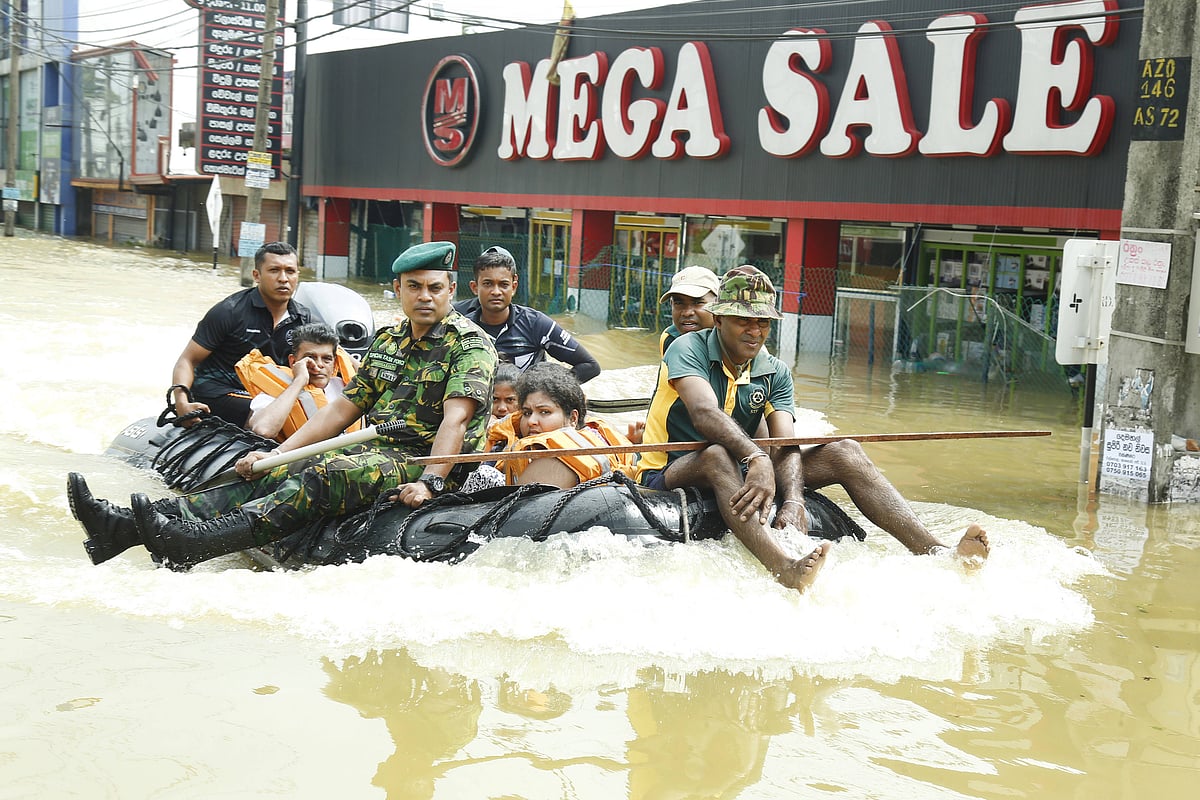
IN JANUARY 2011, I interviewed V Vallipulle as she waited for transport to her home in Vavunathivu in Batticaloa, on the eastern coast of Sri Lanka. She had eaten nothing but boiled potatoes provided by her grama niladhari (local government office) for days. More aid had been promised but had not yet arrived. On that same trip, I met S Indra Kumar, a farmer from Eachchanthivu. He showed us his paddy field, holding up a handful of dead stalks. “All my grain is gone,” he said. I interviewed people as they catalogued their losses: missing fishing boats, damaged nets and cracked walls that would take hundreds of thousands of rupees to repair. These people in Batticaloa had survived the 2004 tsunami and Sri Lanka’s civil war. The floods were just another disaster they had to endure. The report I filed for the Sunday Leader newspaper on 13 January noted that more than half a million people had been impacted by flooding in Batticaloa district alone, with over 160,000 people living in camps.
Memories from those days almost 15 years ago flashed through my mind as my neighbours rushed into my house on 28 November to help my family move our furniture in case of flooding. By this time, 56 people had already lost their lives in Cyclone Ditwah, which made landfall in Sri Lanka early on 28 November. Most of those who had died were from Kandy in the Central Province and from Badulla in the neighbouring Uva Province. That night, I packed a bag as my sister and I argued with my mother about whether or not we should leave. Our lane floods often, as we live next to a canal.
Though the rain had stopped in our area at around 10 pm on 28 November, floodwater from the elevations of the Central Province was still rushing down towards Colombo. At 1 pm, the Irrigation Department sent out a red notice warning that “during the next 24 hours, a High-Risk Flood Situation, of a level not experienced in recent history, may occur in the low-lying areas of the Kelani River Valley.” An earlier notice had warned people in several areas near rivers, including Colombo, to evacuate.
We learnt most of this from social media, through updates from journalists and government agencies like the Disaster Management Centre (DMC), the Department of Meteorology and the Irrigation Department of Sri Lanka. Initially, the alerts from government agencies were mostly in Sinhala, and later on, in both Sinhala and English. As in the past, there were few timely alerts in Tamil, because the DMC did not have full-time staff who could speak the language. The call for volunteers who could speak “multiple languages” went out only on the evening of Saturday, 29 November.