
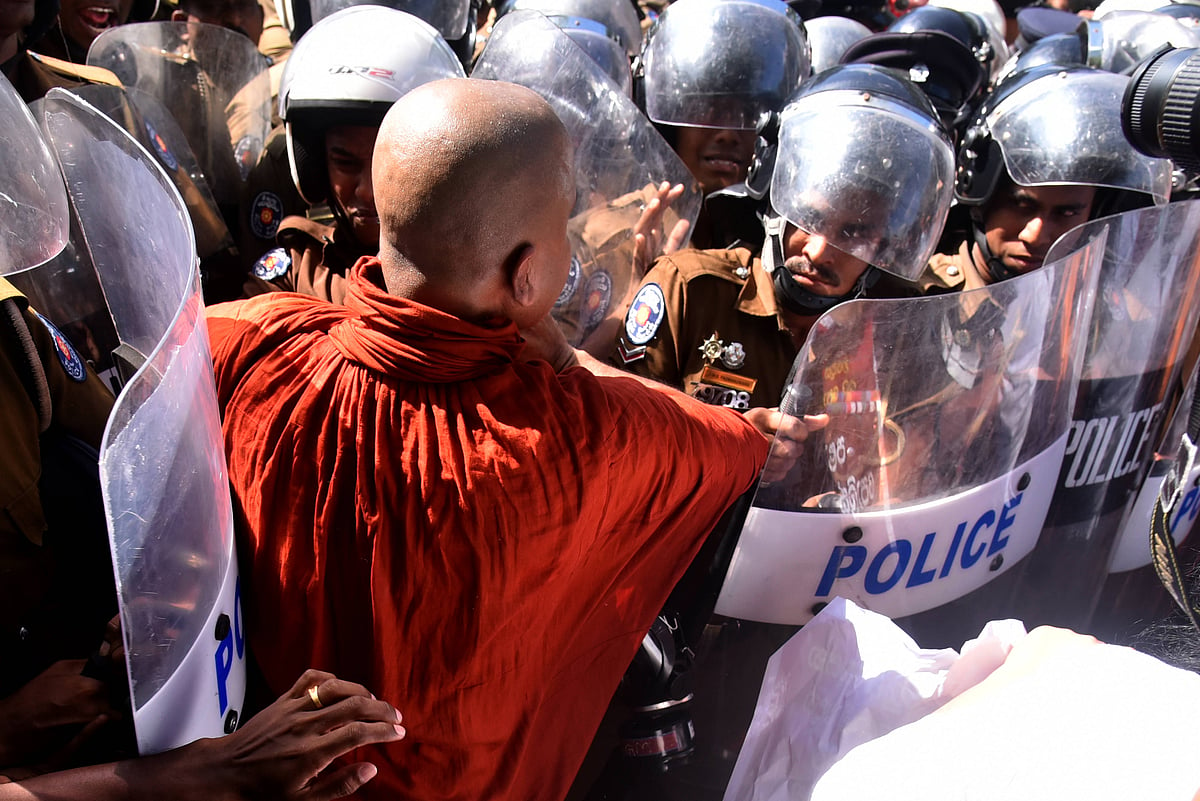
In November, Ranil Wickremesinghe went where no Sri Lankan leader has gone since the tectonic shift in the country's politics in 1956, when Sinhala nationalism had its coming-out party. Wickremesinghe asked monks to stick to their job – instead, it was implied, of dabbling in politics. He also referred to some demonstrating monks as robe-wearing kids. "It is not possible to gain special protection by merely wearing robes and acting against the Dhamma," he chided.
The fact that Wickremesinghe could get away with such a statement is a mark of the times. Sri Lanka's monks, for decades deeply enmeshed in its politics, reached the apotheosis of their influence in the 2019 and 2020 elections, when the Buddhist clergy was the most visible, vocal and committed component of the Rajapaksa support base. Monks worked tirelessly for the victory of Gotabaya Rajapaksa in the 2019 presidential election, and of Mahinda Rajapaksa and the Sri Lanka Podujana Peramuna (SLPP) in the 2020 parliamentary election. Buddhist temples across the land were transformed into de facto propaganda offices. Voting for the Rajapaksas was depicted as not just a patriotic but also a religious duty.
Then, after the Rajapaksas' misrule sank Sri Lanka into an economic and existential crisis, and the massive protests of 2022 forced the brothers out of power, political monks began to distance themselves from the Rajapaksa family. Some lapsed into silence; others remade themselves as virulent Rajapaksa critics. The Aragalaya, the mass movement that overthrew the Rajapaksas, was initially non-religious. When a prominent political monk tried to join a protest near the parliament building in Colombo, he was respectfully told to leave. A hand-drawn poster held up by a young protester in Kandy expressed the new mood: it depicted a rogues' gallery of top pro-Rajapaksa monks, with the caption: "Become Ordained at least now." The implicit message, as in Wickremesinghe's statement in parliament, was to stop playing politics.
But monks and priests made inroads into the movement, and before long many leading Aragalaya activists sought validation from Buddhist prelates, visiting them with gifts rather like the politicians they claimed to despise. The Aragalaya was transformed from non-religious to multi-religious, with mostly Buddhist and Christian as well as some Muslim clergy joining the fold. Saffron robes and cassocks became prominent at press conferences held by movement activists. (Meanwhile, women were either absent or only nominally present; the Aragalaya's public faces were almost all male – and Sinhala.)