
A few days after Kandy District in central Sri Lanka experienced a spate of violent incidents targeting Muslims, resulting in deaths, injury and destruction of property, the country's election commissioner made a startling observation. "The claim that a majority of Sinhalese were against the recent attacks on Muslims is wrong," Mahinda Deshapriya said at a workshop on ethnic harmony; "Most Sinhalese are happy about the riots." He then drew a parallel between this and the majoritarian reaction to Black July: "A majority of Sinhalese were happy to see the Tamils too being attacked in 1983, only to regret it a few years later." He also spoke of an increasingly visible trend towards cultural insularity on the part of some Lankan Muslims, arguing that this was worsening the problem of communal distrust.
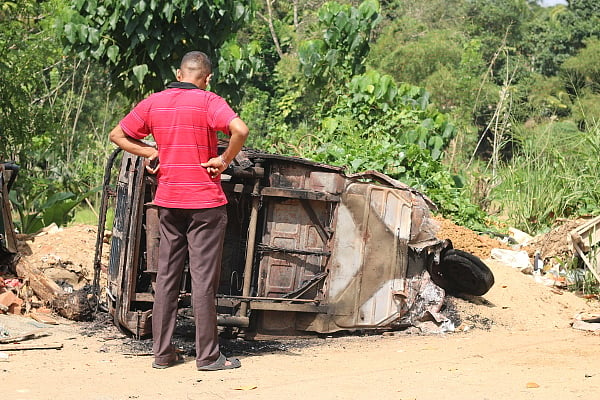
In the absence of credible opinion polling, it is not possible to make a scientific evaluation of Mr. Deshapriya's claim. The only available yardsticks are what happened and didn't happen when mobs started roaming freely, attacking and burning Muslim-owned shops, homes and mosques. When the violence was finally brought under control, including through the imposition of a national emergency, curfew and deployment of forces, at least two persons had been killed and 465 houses, business establishments and vehicles were destroyed or damaged by the violence according to official estimates.
What happened in response, was, in the main, silence and inaction, denoting indifference, approbation or a combination thereof. The government was caught napping. Even when a curfew was imposed, it was not enforced.
Only a few politicians and public figures condemned the violence outright; unequivocal statements from non-Muslim religious leaders were even rarer. Most of those who spoke preferred to hide behind the myth of a Sinhala-Muslim clash, even though what happened was an attack on Muslims by Sinhalese with the connivance of members of the elite paramilitary unit, the Special Task Force of the Sri Lankan police.