
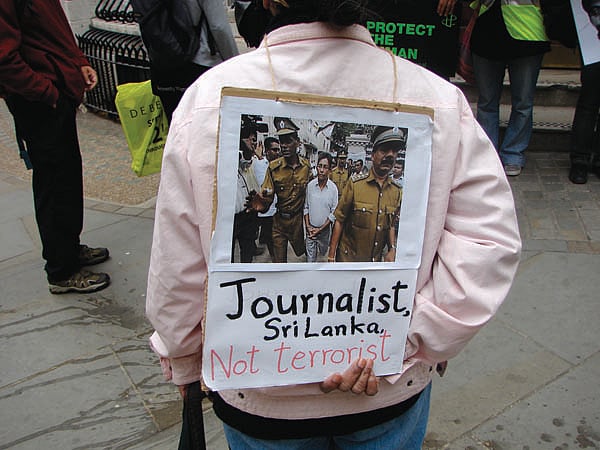
On 7 June, a three-day workshop on investigative journalism organised by Transparency International Sri Lanka ended abruptly when the local police ordered its cancellation. A 'well-organised' mob carrying printed placards (complete with colour photographs of some of the journalists) invaded the venue of the workshop, a hotel in the coastal town of Negombo, accusing the trainers and participants of being 'traitors'. Instead of ordering the protestors out, the police demanded the cancellation of the workshop, for the safety of the participants!
The story did not end there. Fourteen Tamil journalists from the war-torn Northern Province were among the workshop participants. They were to stay the night at a five-star hotel in downtown Colombo. The hotel management reportedly received threats, and the journalists were asked to vacate the hotel soon after midnight. When questioned about these developments, Media Minister Keheliya Rambukwella came up with an explanation which seemed straight out of George Orwell's Nineteen Eighty-Four. If the workshop was attacked, the NGOs would have used the incident to make propaganda against Sri Lanka, the Minister opined. He called the police decision to cancel the workshop, "very good". He insisted that the police were motivated by sheer concern for the safety of the journalists.
Earlier this year, a training workshop for Tamil journalists had to be abandoned after a mob led by Buddhist monks invaded the venue. In May 2014, a workshop on corruption was cancelled due to the military's influence. The Army denied pressuring the hotel management: "We only informed them that according to our intelligence sources a group of people are organising a protest rally against the workshop," the military spokesman stated. Subsequently, the owner of the hotel, Deputy Minister Siripala Gamlath, confirmed the allegations: "Our managers told me there is huge pressure from the Army, so I asked the organisers to get permission from the military. They apparently tried until noon, but failed."
Sri Lanka's media consists of 182 registered newspapers and magazines, 48 registered radio channels and 21 registered TV channels. Apart from one newspaper, two radio stations and two TV stations, all other media outlets are privately owned. There is no official censorship in Sri Lanka. The government's many and generous gifts to media personnel include free laptops, duty-free vehicle permits and low-interest loans. In December 2013, Minister Rambukwella revealed that 91 media personnel had obtained duty-free vehicle permits, and 496 media personnel were given free laptops.