
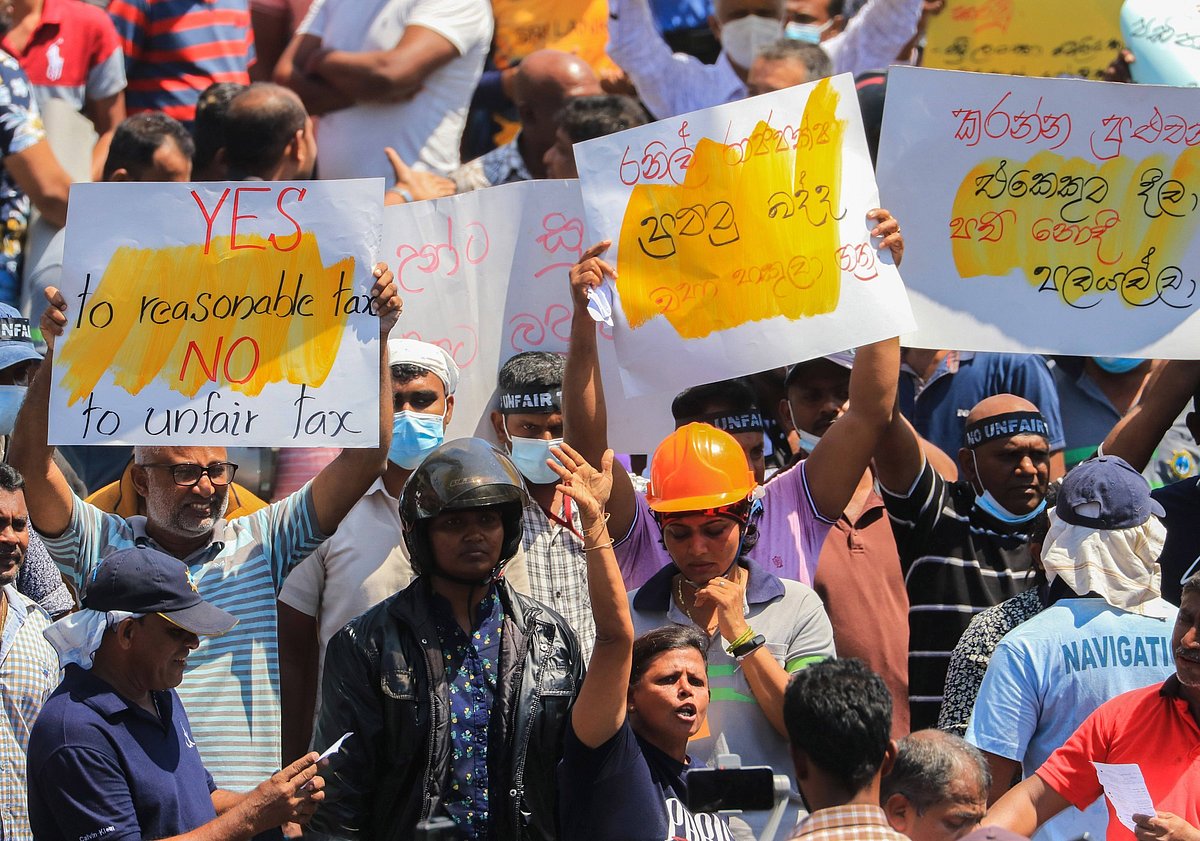
Sri Lankans entered 2023 with an unwelcome gift from the government – a new income tax policy. This was meant to bolster empty public coffers as the government tries to navigate the country's economic crisis, but for ordinary people already facing difficulty on every front it was one more blow from the same ruling class that created the mess in the first place. Already, triggered by the new tax policy, protests against the government by large numbers of middle-class professionals have become a regular occurrence. These protests have the potential to spread among other social strata too: the poor and working classes also feel mounting despair because of unrelenting economic hardship. In a situation where most of the burden of Sri Lanka's economic recovery has been passed on to these social classes, a new wave of popular outrage against the ruling elites cannot be ruled out, and there is speculation that renewed citizens' protests this year may well be more widespread and militant than those that shook the country in 2022.
Two themes dominate the political debate in Sri Lanka at present: managing the economic crisis through restructuring sovereign debt and the local government elections announced for March 2023. Debt restructuring talks have begun, but there is yet no concrete plan of action agreed upon between the government and its creditors, for two reasons. First is the delay of the Chinese and Indian governments in agreeing to join international private creditors at the negotiation table, and the resultant hold-up in IMF approval for Sri Lanka's debt restructuring plan, which would unlock an IMF bailout. Despite the deadlock, the Sri Lankan government has already begun to implement key elements of an economic "recovery" programme that officials admit has been proposed by the IMF. The government and bureaucracy have embraced with shameless enthusiasm a new phase of neoliberal economic reforms, hoping to manage a crisis caused by the same brand of neoliberal policies implemented some years ago.
A key component of the IMF-inspired programme is the drastic increase in personal income taxes, targeting the professional class and medium-sized business owners. At the same time, charges for electricity, fuel, gas, water and telecommunication services are also being dramatically increased. What many people find most predatory is the subjection of individual incomes above LKR 125,000 per month to a tax rate starting at 6 percent. After a sharp slide against the US dollar, LKR 125,000 translates at present to less than USD 350. For larger incomes, the tax rate now stands as high as 36 percent. In view of the rising cost of living and exceedingly high inflation – the inflation rate has been well above 50 percent – many middle-class families are finding the new tax regime ruinous.
Most of those who have already joined the middle-class protests, many wearing black clothes and bands, are public-sector employees in higher income brackets – university academics, doctors, executives at the Central Bank and public corporations. This indicates a new phase of politicisation among previously affluent sections of society whose economic security has already been severely undermined by the prolonged economic crisis since 2020.