
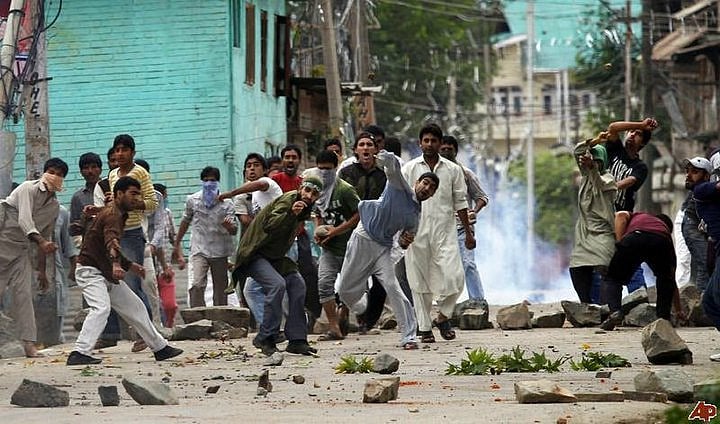
I visited Srinagar – the summer capital of India-occupied Kashmir in January 2016. As a student of history, I went fully conscious of the vexed incorporation of the territory of this erstwhile princely state into India in October 1947 in the name of "national unity and integrity". Consequently, I had few illusions about the ever-widening gap between the ideals of India's democracy and their practical manifestation in its relationship with Kashmir since. Put simply, this relationship reduces Kashmir to one among many, what anthropologist Kamala Visweswaran calls, "geographies of everyday occupation" of social and individual life by the state apparatus. Yet, I was taken aback by the latter's overt omnipresence, ostensibly, during "peace" time. Given this oppressive military and para-military penetration of the landscape, especially in the last 25 years, it is no wonder that the civilian uprisings of 1990, 2008 and 2010 and now, in 2016, represent a cyclic pattern of violence, which will continue unabated, until and unless the Indian State genuinely engages with the Kashmiri people and their aspirations.
I was not to know then that six months later, yet another round of protests and a brutal military response would begin; one with an immediate trigger (the death of the charismatic militant leader Burhan Muzaffar Wani), but well-located in the longue duree of structural "domination" over individual "resistance". Back in January, as I came out of the Srinagar International Airport and reached the exit gate, two sights competed for my attention: a row of shops on the left in a small semi-circle, populated by men in pherans, and a cluster of personnel from the Indian armed forces in combat fatigues. Their vehicles stood near. My host was having tea in one of the shops. He came running past both the pherans and the fatigues, hugged me and welcomed me with these words – "this boy is a jet fighter", commenting on how fast I had reached the exit gate. I could not help but smile at first but then I thought about the words "jet fighter" and found it rather appropriate given the bunkers one saw around the runway; the army's presence in this heavily-militarised state has affected the cultural lexicon of the region.
According to British-Marxist historian, Perry Anderson, military presence has, post-Second World War and in the postcolonial world, usually appeared in two forms – for an "emergency" in the peripheral areas or as a "dictatorship at the centre". In this case, it is the Indian bayonets and state violence in Kashmir that belies the myth that "democracy" exists in the state. As we made our way towards the city-centre, the usual sights of expanding suburbia took over; foremost among them being houses – rather big and impressive. "Kothis" – I uttered; my friend responded with "new money" – indicating the increasing gentrification of the region. The sight of these kothis and their high walls was periodically interjected and over-shadowed by the Central Reserve Police Force (CRPF) camps, buildings and numerous battalions, protected by barbed wire. I was soon to realise that the CRPF presence on Srinagar roads and neighbourhoods was ubiquitous. I would keep exclaiming about this during the trip and eventually feel both foolish and ashamed for doing so; it was only to my "new" non-Kashmiri eyes that the oppressive military presence appeared extraordinary. For my friend, they were merely a "part of the landscape".
In 2012-2013, according to figures quoted in The Indian Ideology by Perry Anderson, there were about 400,000 men from various army battalions and paramilitary forces who were present among the five million strong Kashmiri populace at the time – a ratio higher than in Tibet, Palestine or, lately, even in Iraq. It is necessitated because the Indian State, after securing the Valley of Kashmir in 1947-49 (courtesy a lapsed imperial decree, a forged accession and a false promise of plebiscite) can hold on to Kashmir only if it indefinitely maintains its military numbers in the state to intimidate and keep the population under intense scrutiny.