
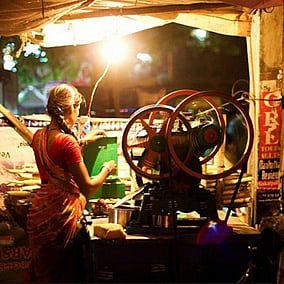
India's Street Vendors (Protection of Livelihood and Regulation of Street Vending) Act, 2014, received presidential assent on 4 March, thereby legitimising street vending as a lawful pursuit. The Act defines a street vendor as "a person engaged in vending of articles, goods, wares, food items or merchandise of everyday use or offering services to the general public, in a street, lane, side walk, footpath, pavement, public park or any other public place or private area, from a temporary built up structure or by moving from place to place." The National Policy on Urban Street Vendors, 2004, which was the predecessor to the revised National Policy of 2009, estimated that there are approximately 10 million street vendors in the country. The services they provide to the urban poor, by offering food and essential commodities at affordable prices, are often overlooked. Instead, street vendors are perceived as encroachers of public spaces by the police, local authorities and a section of the public, and are subject to harassment and forced eviction.
The Act, which aims to "protect the rights of the urban street vendors and to regulate street vending activities", nonetheless ignores important provisions laid down in the National Policy on Urban Street Vendors, 2009, and many recommendations put forward by the Standing Committee on Urban Development (15th Lok Sabha) in its report of March 2013. Had lawmakers been sensitive to the spirit of the National Policy and the Standing Committee report, the Act could have taken advantage of an excellent opportunity to address the problems of street vendors.
Meaningful omissions
Enforcement of the Act is the responsibility of state governments, and so far more than 10 states, including Punjab, Maharashtra and Rajasthan, have started implementing the Act. The National Association of Street Vendors of India (NASVI) has set a goal of ensuring that the Act is implemented in at least 100 Indian cities by May 2015. The close attention of state authorities in a number of areas is crucial to ensure the gaps between the National Policy and the Act are filled.
First, the National Policy of 2009 specifically mentions the provision of civic facilities such as solid waste disposal, public toilets, electricity, and drinking water in places where vending is allowed. The provision of these facilities is aimed at institutionalising street vending as a sustainable form of livelihood, and enabling street vendors to pursue their businesses more conveniently and with minimal environmental impact. While the Act entrusts the appropriate authorities with collecting the vending fee charged for the civic facilities offered, it contains no explicit guarantee that all such facilities will be provided. The absence of the aforementioned provisions can make street vending less sustainable and more damaging to the environment.