
In a tiny room with blue walls full of charts about birds, fruits and vegetables, 10-year-old Tamanna sits on the floor, drawing on sheets of paper strategically folded to resemble greeting cards. The room, on the first floor of a modest dwelling in the Siding Service locality of Ahmedabad, for the past seven months has been hosting a learning centre run by the NGO Pratham. "Earlier, we were in the Muslim part of the area," says Kanchanben Rathod, a teacher. "But Hindu children, especially girls, wouldn't come there, so we had to move to this place." Tamanna, whose shy smiles preface her every sentence, interjects: "The Muslim children were troubling us; we were frightened of them. So I stopped going there."
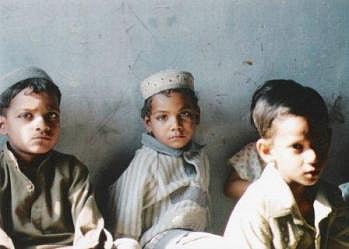
A few kilometres away at Allah Nagar, where vegetable vendors, children and goats jostle for space in the narrow paths of the slum settlement, is another learning centre managed by Pratham. Many of these children, also leaning against blue walls as they open their bags, wear skull caps. Mothers bring little girls, often wailing as they shake their pigtails in defiance, into the classroom, and stop to chat with the teacher. There are no Hindus in this area, and certainly none in the classroom. Both the children and their mothers speak of their lives inside the slum, having little or no contact with the world that lies beyond their inadequately covered shacks and the dusty, fly-infested lanes outside their homes.
Last November in Ahmedabad, where almost everyone is forced to navigate between real and imagined boundaries drawn on the basis of religion, a few social workers got together to attempt to bridge the divide between Siding Service and Allah Nagar. They organised a cricket match for the children. That game quickly came to be referred to as the "India-Pakistan" match, says Jigna Rathod, who works with Pratham. "Sometimes, children say such things," she adds. Afterwards, the children traded insults and threw stones, recalls Anjana Parmar, another Pratham worker. Clearly, even a playground could not be neutral terrain, with the scorecard heavy with bias and prejudice before the game could even get underway.
Mind-boggling borders
A policeman snoozes inside a khaki tent pitched on a lane that forms the 'border' in the Parikshit area of the city. He, and usually his colleagues, are ostensibly here to douse the neighbourhood quarrels that end up taking on communal overtones. Their presence is a forbidding indicator of the omnipresent possibility of clashes between Muslims and Hindus in the area, separated by a 'border' – a term that Ahmedabad's residents mention casually, as if indicating something as mundane as a traffic light that serves as a landmark (See Himal October 2006, "Gujarat as another country").