
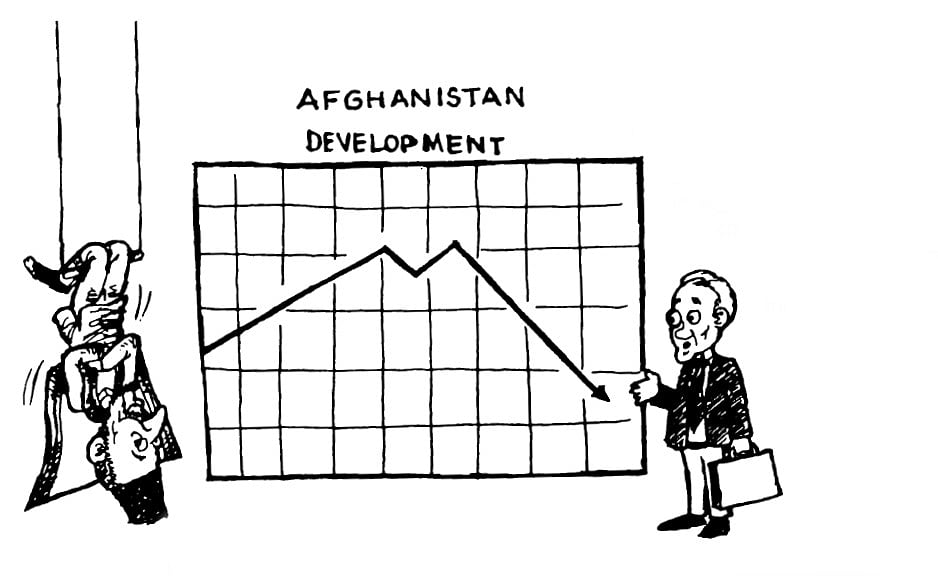
During the last seven years, the US and the international donor community have spent some USD 15 to 31 billion on rebuilding, development and democratisation activities in Afghanistan. Today, the tangible result of this work seems to be the population of some nine million citizens suffering acute food insecurity, and millions of others facing widespread violence, endemic corruption and political anarchy. When asked about the progress made in the past several years, President Hamid Karzai and his Western backers revert to what seems to be a pre-recorded mantra: five million refugees have returned home; over five million children now go to school; an enlightened constitution has been enacted; and elections have taken place, allowing democracy to take root. Meanwhile, few politicians, if any, like to talk about the significant problems that have cropped up in the disbursement of international aid, nor about the widespread corruption and misuse of these funds.
The NGO business has boomed in post-Taliban Afghanistan, greased by the significant inflow of aid money. Hundreds of Afghan and international organisations currently operate in the country, with most of the latter restricting their work to the north and central regions due to the lack of security elsewhere. Yet for all of these eyes ostensibly on the ground, there remain large gaps in basic knowledge. To begin with, neither Kabul nor any one of the Western capitals has a very good idea of how many people actually live in Afghanistan. The lack of a reliable census – due to insecurity and deficiency in funding and other technical support – has not only adversely impacted on development policies (particularly in the planning phases), but also creates confusion in implementation and uncertainty at the national and local levels. Yet the government and the aid agencies nonetheless continue to claim to have improved living conditions for all. Such self-congratulation seems inappropriate because incomplete data makes it impossible to judge the scope and depth of the impact of aid money.
Particularly disturbing of late has been the trend of bringing more international workers to the already inflated donor-agency circuit in Kabul, even as these very organisations have lost access to almost half of the country. For instance, in 2009 the UN Assistance Mission in Afghanistan (UNAMA) is set to hire 2000 additional well-paid international staffers, which is a massive number by any measure. In December of last year, this writer asked Kai Eide, special representative of the UN secretary-general for Afghanistan, about the benefit of employing so many more non-Afghans to work from fortified compounds in Kabul. His response – that it is Afghan staffers, not internationals, that constitute a "tremendous asset" – does not explain his own organisation's habits.
Inequality between local and international staffers is inherent in the UN system. Apart from the massive security expenditure needed for foreign workers (armoured vehicles, armed escorts), an 'international' earns an average of ten times more than does a locally national worker. And the problem is far from limited to the UN system. From 2002 to 2007, more than USD 380 million was spent on technical-assistance activities, meaning the recruitment of advisors to build the capacity of Afghans in various areas. During that period, donors have also paid more than USD 150 million to the United Nations Human Air Service (UNHAS), a private air-service provider that flies international staffers from the UN and other organisations in and out of Afghanistan, most to Islamabad for international connections. Tellingly, none of these funders has offered support to protect Ariana, Afghanistan's only national airline, from economic collapse.