
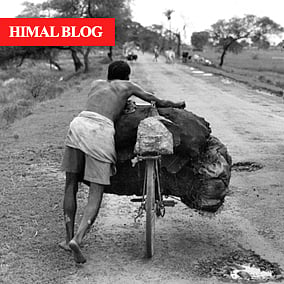
The Census of India 2011 shows that 833 million of the country's 1.21 billion people live in rural India. It is this vast cross-section of the population and their lives – largely ignored by the media – that forms the subject of People's Archive of Rural India (PARI). Launched by the veteran rural reporter and Magsayay Award winner P Sainath, the people's archive encompasses a wide spectrum of rural India: from the grim realities of the farming crisis and resource conflicts, to the colourful aspects of its culture and folklore. It catalogues the complexities of rural India through a combination of photographs, videos, reports and slideshows, with sections such as 'Talking Albums' and 'Faces'. Women's contribution in rural labour, largely unrecognised across India and Southasia, gets its due in the section 'Visible Work, Invisible Women'.
A Southasian predicament
"While South Asian societies have differences, there are considerable commonalities in caste structures and ruralities," says Sainath. "Problems of hunger, poverty, large scale migration and unemployment which either have their origins in, or are linked to the rural, are visible across Southasia. Many Southasian societies are also undergoing crises of health and water. Neoliberal transformations across the region have strengthened what is worse and taken away much that is worth cherishing. For instance, the feudal khaps in [the Indian state of] Haryana have become only stronger, while traditional occupations such as weaving and folk art have been eroded."
The predicament of the rural is not confined to India. According to the World Bank, 67 percent of Southasia's population is rural, making it a region with one of the largest rural populations in the world. It also has the largest concentration of the world's poor.
With its rural focus, PARI represents a model of archiving that can be studied and emulated by other Southasian countries to address the asymmetries in the documentation of their rural societies. The project has volunteers from a wide range of professions, from journalism and academics, to science, finance, photography, filmmaking and IT. Its 'Resources' section is a growing compilation of reports and studies on rural India. Importantly, PARI gives public credit to and privileges the ownership of individuals over their stories.