
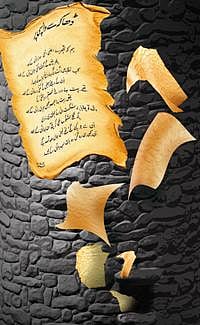
Faiz Ahmed Faiz remains one of the great unsolved enigmas of Southasian literature. Where does Faiz the poet end and Faiz the politician begin? Where does the pan-Southasian Marxist end and the Pakistani begin? His engagement with these contradictory identities constitutes a painful puzzle for his admirers. This becomes all the more complex because Faiz never seemed to have belonged fully to any one land – the boundaries of his literary, political and cultural life are fluid, flowing and overlapping.
The issue becomes even more complex for a Bangladeshi admirer such as this writer, who was born in the 1950s and to whom Faiz offers a complex identity and a bonding to great ideals crossing all borders. He is one Pakistani whom Bangladeshis have looked upon with the greatest possible admiration and affection. Yet what challenges this bond is the Faiz of during and immediately after 1971. During those terrible days, Bangladeshis who knew about or of him would ask each other, What is Faiz saying about all this? He had become the 'Good Pakistani' in the eyes of those in the East. Yet, was Faiz ever a person who represented more than Pakistan? Was it possible for him to escape being a Pakistani and have a wider identity encompassing all the admiring nations of Southasia and beyond?
During the late 1960s, Munir Chowdhury hosted a literary television show in East Pakistan, during which he would discuss various writers of Pakistan. He was a legendary speaker, and employed his dramatic skills to present literary luminaries to a devoted public. In one show he talked about Faiz, his friend and fellow-traveller. Chowdhury focused on the poem 'Mujhse pahli si muhabbat mere mehboob na maang', presenting Faiz as a social revolutionary and a poet of the oppressed. This presentation suited Chowdhury, who had been a Communist Party member, jailed in 1952 for his activism during the Bengali-focused Language Movement, and a lifelong literary activist who had become an icon of Bengali nationalism. He had moved on from his firebrand days, however, to become more a writer than a politician, an unparalleled teacher and East Pakistan's leading dramatist.
Most importantly, Chowdhury's love for Faiz's poetry was real. His introduction was one of the memorable moments of my life, an introduction to a poet of passion and beauty whom I admire to this day. Though I understand little of the literary tradition that Faiz upholds or the magnificent language of his poetry, I appreciate it – somewhere, there is a deep bond that transcends poetic pursuits. Yet my affection is also tinged with pain, as I see Faiz nationalised, regionalised, made language-specific. This is a tragedy for a poet who spoke to all of us once.