
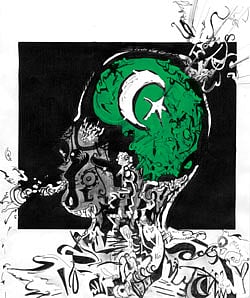
On 17 August 1947, after just three days of independence in Pakistan, Muhammad Abdullah Quereshi, a politician, published an article in an Urdu newspaper titled "A Need to Change and Amend the History Curriculum". In it, Quereshi suggested that, during the colonial period, the history of Muslims in Southasia had been distorted by both the British and the Hindus of India, with the motive of diminishing their achievements. Therefore, Quereshi argued, the current context offered an opportunity to correct historical facts, and to rewrite the past in a way that highlighted the contributions that had been made by Muslims to the world. He also expressed his satisfaction that the government of Punjab province had already set up a committee to design history courses. Thus, from the very beginning of the country's creation, history has been used as a tool to formulate and propagate the ideology of Pakistan – a process that was, of course, in the interests of the country's ruling classes.
At its birth, Pakistan, with an emerging society, inherited three elements as part of the Indian Muslim ideological legacy. Foremost amongst these was the poetry of Altaf Hussain Hali and Muhammad Iqbal, structured around an illusion of a supposedly glorious past; this enthralled readers, and gave birth to revivalist movements of all hues. Second, having developed something of an inferiority complex and a sense of insecurity, Muslims of the Subcontinent adopted an anti-Hindu attitude – one that was, by default, also anti-democratic. Third, the leadership in Pakistan quickly turned to dealing with all political issues in a sentimental rather than rational manner.
When the demand for the creation of Pakistan was first put forward, it quickly shaped itself into a claim for a separate homeland for Muslims, where they could live according to their beliefs. Consequently, separation rather than integration became the core of the Pakistan Movement. Today, 61 years after Independence, when Pakistanis look back at their own history these elements can still be found in the country's body politic.
After the creation of Pakistan, the new nation state faced a number of political, social, economic and cultural crises. The country survived, however, and eventually took a course that was supposed to help in determining its identity. Playing a notably important role in the shaping of this identity, and in determining its destiny, was a question that formed the core of a very particular national ideology: How to carve out an identity separate from India. If India was secular, then Pakistan had to be Islamic, if for no other reason than to justify Partition.