
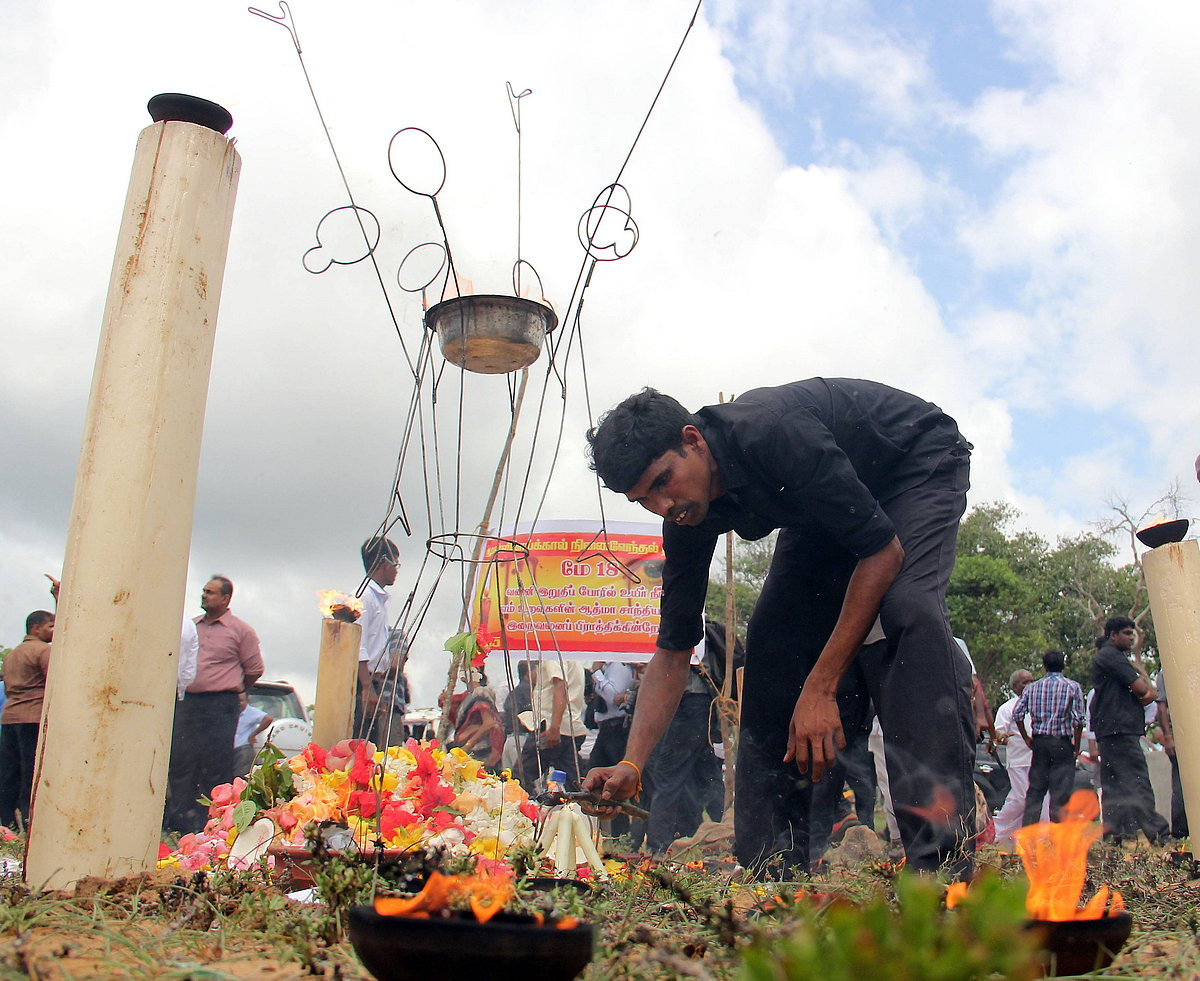
On May 18 2023, Eelam Tamils came together to commemorate Tamil Genocide Remembrance Day, also referred to as Mullivaikal Remembrance Day, marking the end of the war between the Sri Lankan state and the Liberation Tigers of Tamil Eelam (LTTE). In the North and East of Sri Lanka – the traditional homeland claimed by Tamils, stretching between Amparai and Jaffna – various events were held in schools, temples, churches and other public places. Kanchi, the simple rice porridge provided by the LTTE that gave meagre sustenance to those surrounded by state forces in the final months of fighting, was symbolically handed out to passers-by in coconut shells. In many places, these commemorations were met with harassment by the police and military forces. In Trincomalee, a court banned members of civil society from organising any events. All of this fits a familiar pattern: the destruction of Tamil memorials to those who died in the war, the arrests of organisers and harassment of participants at remembrance events, have continued year after year since the end of the war in 2009, and are intended to stamp out Tamil commemoration by increasing the risks of participation.
The most prominent gathering every year happens in Mullivaikkal, the small hamlet on the coast of Mullaitivu that has become eponymous with the massacre that occurred here in 2009. Every year, attendees light flames and lay flowers at a memorial shrine located on a sandy clearing amid the thorny shrubs that dot the local landscape, a stone's throw from the beach. Amid the wails of the grieving, defiant songs are played over tinny loudspeakers, mourning the dead and invoking Tamil Eelam – the proposed state that the LTTE fought for. All of this is done under the watchful eye of the security forces. Plain-clothes informants are known to mingle in the crowds.
It is important to understand this about the Sri Lankan state's hostility to Tamil nationalism: it's not Tamil identity on its own that the state opposes. Tamils are targeted because Eelam Tamil nationalist mobilisation has been the single most potent challenge to Sinhala Buddhist supremacy. By this logic, Tamils must continuously be treated as a threat, as their political identity is incompatible with the Sinhala ethnocracy the state has been building since independence. But despite the often brutal repression of Tamils and their political aspirations, the process of making an Eelam Tamil nation, started by the political leader Chelvanayagam's Federal Party in the early 1950s and later institutionalised by the LTTE, has continued, even beyond the end of the war. The success of the continued normalisation of Tamil nationalism among the Eelam Tamil masses becomes most apparent during public rallies and events on 18 May and on 27 November – the day of Maaveerar Naal, when fallen LTTE cadres are remembered. The Sri Lankan state's reflexive repression of these events is a symptom of its refusal to deal meaningfully with the nationalist aspirations that sustain them – an approach that now, like in the past, singularly fails to deal with the heart of the problem.
Never forget