
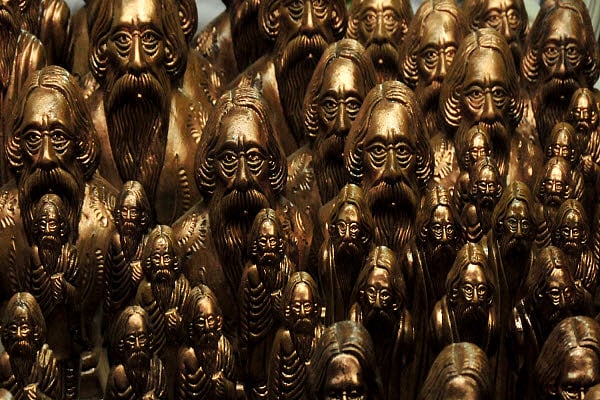
Is it time people stopped seeing Tasher Desh (The Land of Cards) as a children's play? "Oh yes," chuckles Q. "We've f****d it!"
The pride in the 'achievement' is unmistakable. It is no different from that of a child who has just broken the glass panes in his classroom to protest being thrown out for not getting his pronunciations right. Well, actually, it is almost like that. "I used to be pulled up by teachers and elders for not singing Tagore in their way, the 'right way', which they said was the only way. Even when you mentioned his name it had to be done in a certain way, the whole body language changed," Q says. The rigid Tagoreana of self-appointed Tagore custodians put him off.
Qaushiq Mukherjee, who named himself Q more than a decade ago when he began a career in filmmaking, is now the creator of his own version of Tasher Desh, a cinematic adaptation of the musical drama penned by Rabindranath Tagore in 1933 drawing inspiration from Lewis Carroll's Alice in Wonderland. Internationally known as a poet and a mystic, Tagore won the Nobel Prize for Literature 100 years ago for his collection of poems Gitanjali.
This is the first time that a Tagore play has been adapted into a feature film. Film directors in the past, including Satyajit Ray, have put novels and short stories on celluloid. On its website, Q's production company Overdose Joint describes Tasher Desh as "a psychedelic musical adventure of a storyteller, encountering catharsis, an oracle, a widow and fascists [sic] cards before finding love. The story of reincarnation in real time unfolds inside the darkness of his mind, a kaleidoscope of fantasy, taking him on a journey to the regimented land of cards."