
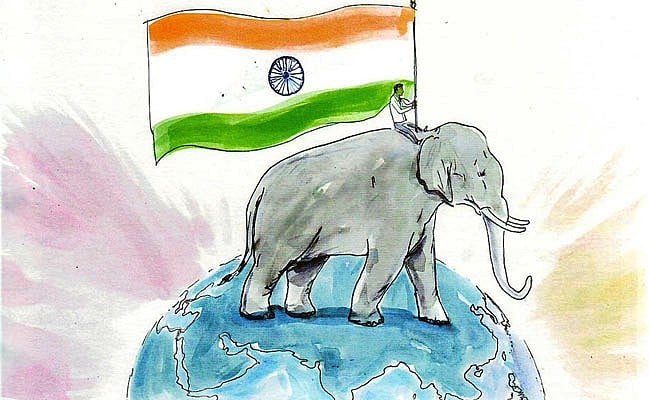
Foreign policy has not been a popular subject in India – even among the intelligentsia – till recently. Even those engaged with the strategic and diplomatic aspects of foreign policy – economic aspects are largely ignored – are unsure about what India ought to be doing or saying. Many of them consider themselves to be realists in the realpolitik sense and think that India should adopt whatever policy benefits the country. There was a time in the early part of this century when experts argued against the United Nations, saying policy should be pursued outside its inane ambit. At the same time others argued for UN reforms and permanent membership of the UN Security Council for India. There are some who advocate a conciliatory attitude towards Pakistan and a tough stance against China, arguing this would position India better with the still- influential First World of Europe and the United States. Others think the opposite. The state of foreign policy debate in India is deliriously confusing.
This confusion however does not prevent members of the intelligentsia from talking with remarkable confidence about issues on which the facts are not fully known. An example is the talk on how Jawarharlal Nehru failed on the Chinese front and bungled his Kashmir policy. Nehru is blamed for allowing thousands of miles of territory to be occupied by the sharp Communist rulers in Beijing and for a part of Jammu and Kashmir falling into Pakistani occupation Azad Kashmir / Pakistan-occupied Kashmir (PoK) / Pakistan-administered-Kashmir (PAK) following the first India-Pakistan war of 1948. Nehru is also squarely blamed for losing the 1962 war with China. This is a view popular at street-corners and in coffee houses, in drawing rooms as well as with right-wing political circles. Informed academic debates do not allow for this kind of a popular view because of the complexity of the situation and the fact that the full facts are still-to-be unearthed from archives in New Delhi, Islamabad, London, Washington and Moscow.
There is also the rosy view that India under Nehru was a world leader because of its idealistic and moralist non-aligned approach that was looked up to. This view argues that the lofty stance was sacrificed at the altar of economic reforms which were ushered in 1991, consequently making India a pygmy on the international stage despite impressive economic performance. There is also the pungent criticism – especially from the Left, (including the Indian Communist parties) – that says India is now a meek camp follower of the United States and the North Atlantic Treaty Organisation (NATO), and that in diplomatic, strategic and economic spheres New Delhi is toeing the Washington line.
There have been book-length arguments in the last 20 years, quite a few of them from Indians working in the American universities and think-tanks. But they focus largely on specific aspects of India's relations. There have been a couple of books on India-US relations, books on India's nuclear policy and its strategic implications, books with contributions from Indian and Pakistani scholars and policy-makers about bilateral relations, sometimes focused on a specific topic like the Shimla Agreement of 1972. There have been a quite a few from Indian and foreign journalists about India and China as emerging economic powerhouses but not much has been written on the foreign policies of the two countries which should make a fascinating study in itself. Despite considerable publishing in this sphere, there have been no book-length discussions about Indian foreign policy in its entirety.